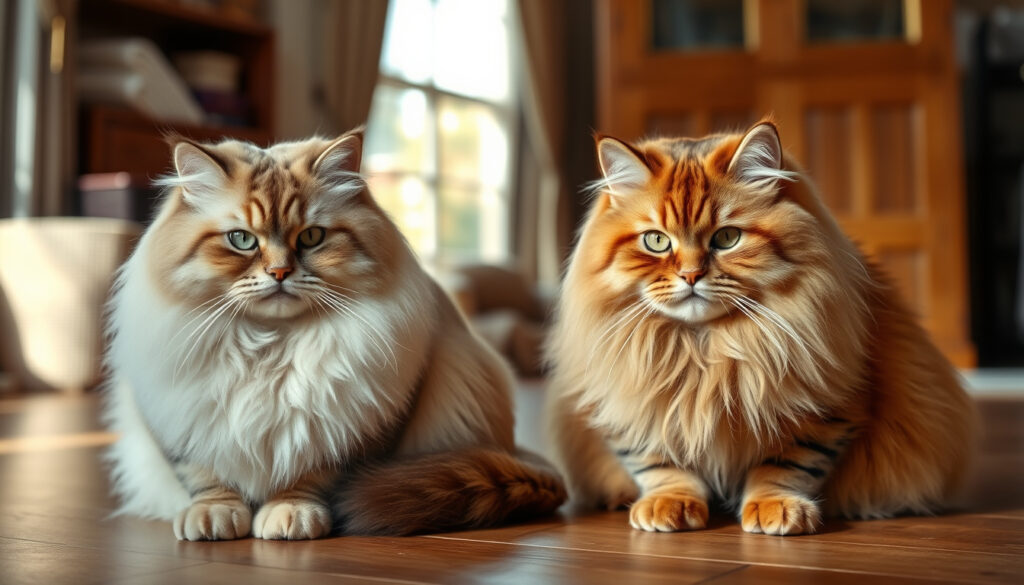
Siberian Cat: UK Price, Temperament, Colors & Norwegian Forest
Anyone who has watched a Siberian cat walk across a wet lawn understands why the breed has a reputation for being waterproof: the triple coat is built to shed weather, not absorb it.
Average weight: Male 6–9 kg, Female 4–6 kg · Lifespan: 12–15 years · Coat type: Triple-layered, water-resistant · Hypoallergenic: Produces lower Fel d 1 levels · Price range in UK: £800–£1,500
- Affectionate and people-oriented
- Good with children and other pets
- Calm and playful
- Medium to large, muscular body
- Thick triple coat in many colors
- Round eyes and fluffy ears
- UK price £800–£1,500
- Breeders across the UK
- Hypoallergenic trait increases demand
- Life expectancy 12–15 years
- Regular grooming needed
- Generally healthy breed
What is the kindest cat ever?
The Siberian cat is not just fluffy; it is a genuine people cat. The breed’s social intelligence and patient temperament make it a candidate for the kindest lap cat, but individual personality still wins over breed reputation.
Chewy describes Siberians as chatty, witty, and sociable, and notes they are gentle and suitable for families with children. The Cat Fanciers’ Association (CFA) echoes this, listing them as moderately active and adaptable. What separates a Siberian from a random friendly cat is the breed’s unusual emotional attunement — they bond closely to their humans and often greet them at the door.
The kindest cat is the one that treats the house like a family meeting: curious, calm, and affectionate. The Siberian fits that description well enough to earn a spot in the “kindest cats” conversation.
That said, kindness is not a breed guarantee. A Siberian raised with rough handling or minimal socialisation can grow into a wary adult. The phrase “kindest cat ever” is a people-pleaser; the more accurate phrase is “a cat bred to be a good family member.”
Are Siberian cats hypoallergenic?
The short answer: no, but they are close. Siberians produce lower levels of the Fel d 1 protein, which is the primary allergen, but no cat is truly hypoallergenic — as the Royal Canin guide points out, anecdotal evidence suggests some allergy sufferers react less strongly to Siberians than to other breeds.
TICA says the breed is “considered a hypo-allergenic cat breed” due to lower Fel d 1-related levels compared with other breeds. However, individual responses vary widely. Some allergy sufferers find they can live with a Siberian; others still react strongly.
If you have cat allergies, spend time with a Siberian before committing. A breeder should let you visit and interact with the cat. The allergy claim is not a myth, but it is not a guarantee either.
The practical implication: Siberian cats are a good starting point for allergy sufferers who want a dog-like cat, but they are not a cure-all. The pattern is consistent across sources — lower Fel d 1, but not zero.
How much do Siberian cats cost in the UK?
A Siberian kitten from a reputable breeder in the UK typically costs £800–£1,500. The price varies based on pedigree, coat colour, and the breeder’s reputation. Some lines — especially those with show titles or rare colours — command higher prices.
The initial cost includes vaccinations, microchipping, and sometimes a health guarantee. But the purchase price is just the beginning. Siberian cats are a large breed that needs high-quality food, regular grooming, and routine vet care. Annual costs for food, litter, and veterinary check-ups typically run £500–£800.
Compare that with a Norwegian Forest Cat, which can cost £700–£1,200 in the UK. The Siberian is often pricier because the hypoallergenic claim drives demand. But the price difference is not huge when you factor in the cat’s lifespan of 12–15 years.
What you are really paying for is a cat that is bred for temperament and health. A well-bred Siberian is a calm, social companion that fits into a family. The premium price is a reflection of the breeder’s investment in health testing and socialisation.
Siberian cat vs Norwegian Forest cat
What is the main difference between a Siberian cat and a Norwegian Forest cat?
The two breeds are often confused because they share a similar wild-forest look, but they have distinct differences in coat structure, size, and personality.
The Siberian has a triple coat (a soft undercoat, a protective topcoat, and a slightly longer outer coat). The Norwegian Forest cat has a double coat, with a dense undercoat and a waterproof topcoat. This is a key difference: the Siberian is built for cold weather, but the Norwegian is even more robustly insulated against the Scandinavian winter.
In terms of size, the Norwegian Forest cat is generally larger and heavier — males can reach 9 kg, whereas male Siberians typically peak at 7–8 kg. The Norwegian has a more prominent ruff, while the Siberian has a more rounded, teddy-bear face.
Personality is where the difference becomes clear. Siberians are more social and playful; they greet people at the door and often follow them around the house. Norwegian Forest cats are more independent and reserved, though they still form strong bonds with their family. If you want a cat that acts like a dog, the Siberian is the better choice. If you want a more self-sufficient cat that tolerates solitude, the Norwegian fits the bill.
What is the rarest color of a Siberian cat?
All colours and patterns are accepted by breed standards, but some are rarer than others. Solid black is considered one of the rarest Siberians, followed by chocolate and colourpoint. The rarest of all is the colourpoint pattern, which requires the colourpoint gene to be present in both parents.
In the UK, the most common colours are tabby, black, and blue. Solid white is also rare, and a white Siberian with blue eyes is highly sought after. Breeders who focus on rare colours often charge a premium, so expect to pay £1,200–£1,500 for a rare-colour kitten.
Siberian cat personality and temperament
Siberian cats are known for their calm, gentle disposition. They are not lap cats in the traditional sense, but they like to be near their humans and will follow them from room to room. They are social, intelligent, and often get on well with children and other pets, including dogs.
Chewy describes them as “chatty, witty, and sociable.” They are not as vocal as a Siamese, but they will meow to get your attention, especially when they want food or playtime. Unlike some breeds that are aloof, Siberians form strong bonds with their family and can become anxious if left alone for long periods.
The breed is also known for its intelligence. Siberians are quick learners and can be trained to walk on a lead or perform simple tricks. They are playful throughout their lives, but they are not hyperactive — they are content with a few play sessions a day, making them a good fit for busy families.
Siberian cat health and care
Siberian cats are generally healthy, with a lifespan of 12–15 years. They are a robust, natural breed — they have not been over-bred to the point of chronic health problems, which is one of the reasons they are so popular. However, they are prone to a few inherited conditions, including hypertrophic cardiomyopathy (HCM) and hip dysplasia.
Regular grooming is essential. The triple coat sheds heavily, especially in spring and autumn. A weekly brushing session will keep the coat in good condition and reduce hairballs. During moulting season, you may need to brush every other day.
The Siberian’s coat is water-repellent, so they do not need frequent baths. A bath every few months is sufficient, unless they get into something messy. They also need regular nail trims, ear cleaning, and dental care.
In terms of diet, Siberian cats need a high-quality, protein-rich food. They are not prone to obesity, but they do have a healthy appetite, so it is important to control portions and provide plenty of exercise.
en.wikipedia.org, chewy.com, gccfcats.org, chewy.com, tica.org, cfa.org, zubairkhalid.com, petful.com, petful.com, royalcanin.com, royalcanin.com, a-z-animals.com
Frequently Asked Questions
Are Siberian cats hypoallergenic?
Siberian cats produce lower levels of the Fel d 1 protein, making them a better choice for allergy sufferers, but they are not completely hypoallergenic. Individual responses vary, so spend time with a Siberian before adopting.
Do Siberian cats like water?
Yes, Siberian cats are known for their love of water. This is a breed that enjoys splashing in sinks, drinking from running taps, and sometimes even joining their owners in the shower.
Do Siberian cats get along with dogs?
Yes, Siberian cats are generally good with dogs. They are confident and social, so they can stand their ground with a friendly dog and often form strong bonds with their canine siblings.
How much do Siberian cats shed?
Siberian cats are moderate shedders, but they moult heavily twice a year. Regular brushing, especially during moulting season, will help manage the shedding.
How long do Siberian cats live?
Siberian cats have a typical lifespan of 12–15 years, though some live longer with good care. They are a generally healthy breed with few breed-specific health problems.
What is the rarest color of a Siberian cat?
The rarest colours of Siberian cats are solid black, chocolate, and colourpoint patterns. These colours are recessive and require specific breeding lines, so they are harder to find and often cost more.
More related posts
 3 Body Problem Season 2 – Confirmed Release, Cast and Updates
 Mt Etna: Current Activity, Safety, Tours & Facts 2026
 Bt Mail Sign In – Complete Guide to Web and App Access
 Kaia Gerber: Model, Actress, and Relationship Timeline
 Luna Lovegood: Profile, House, and Relationships
 What Is a Labubu? Viral Collectible Plush Explained
 La Roche-Posay Sunscreen – Best Picks for Sensitive Skin
 Olivia Attwood: Biography, Age, Relationship, Net Worth & Health