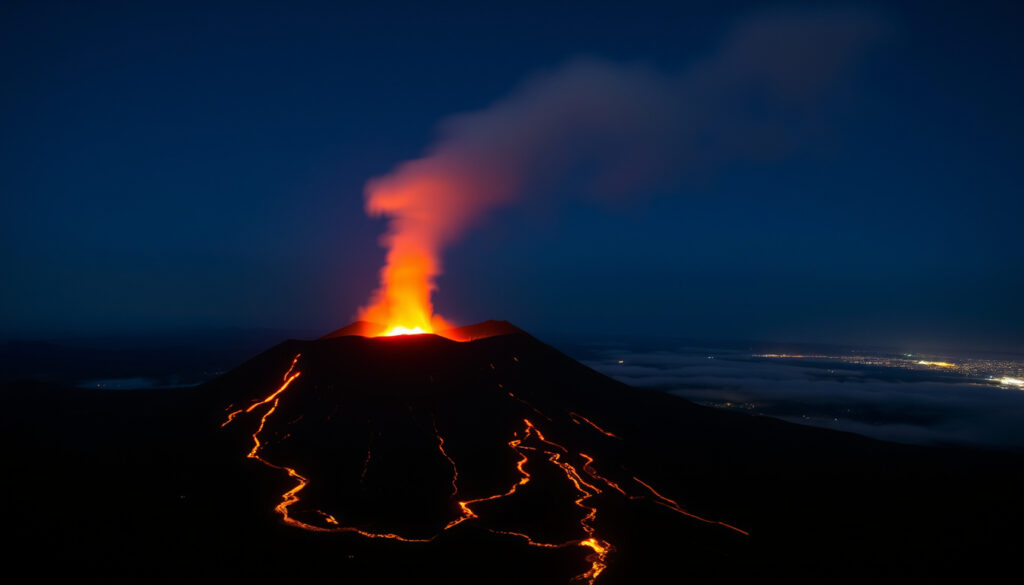
Mt Etna: Current Activity, Safety, Tours & Facts 2026
Every few months, Mount Etna lights up the news feed with lava fountains, yet the volcano keeps doing what it has done for half a million years: erupting. The real challenge is understanding which parts affect your Sicily plans — a recent wire report logged a 400-metre lava fountain near the Southeast Crater, dramatic but confined to the summit.
Active volcano: Yes — near-constant summit activity ·
Height: About 3,323 m (changes with eruptions) ·
Location: Sicily, Italy ·
Type: Stratovolcano ·
UNESCO status: World Heritage Site since 2013
Quick snapshot
- Etna is almost constantly active at its summit craters (INGV Osservatorio Etneo, Italy’s national volcano institute) (Etna current volcanic activity and monitoring)
- Most recent episodes mixed Strombolian bursts, ash emissions, and a 400-metre lava fountain (GDN Online / Reuters) (Etna current volcanic activity and monitoring)
- Check the Etna current volcanic activity and monitoring feed for date-specific alerts
- Lava rarely threatens populated areas during normal summit activity (BlueKeys, Sicily travel operator) (The Watchers, volcano activity tracker)
- Ash can affect roads and Catania airport even without lava risk (RaiNews Sicilia, Italian regional public broadcaster) (The Watchers, volcano activity tracker)
- Official warnings should override assumptions — alert levels exist for a reason (The Watchers, volcano activity tracker)
- Cable car and 4×4 tours operate on the south side (BlueKeys, Sicily travel operator)
- Best hiking months are March to September (BlueKeys, Sicily travel operator)
- Guided tours are the standard way to reach high summit areas (BlueKeys, Sicily travel operator)
- Europe’s highest active volcano — about 3,323 m (INGV Osservatorio Etneo, Italy’s national volcano institute)
- UNESCO World Heritage Site
- Frequent Strombolian eruptions (GDN Online / Reuters)
Six facts, one theme: Etna is a big, busy, officially watched volcano — the numbers below are the ones that matter for planning a visit.
| Attribute | Value |
|---|---|
| Official name | Mount Etna |
| Location | Sicily, Italy |
| Type | Stratovolcano |
| Height | About 3,323 m — the figure changes with eruptions |
| Status | Active — near-constant summit activity, monitored continuously (RaiNews Sicilia, Italian regional public broadcaster) |
| UNESCO World Heritage | Inscribed 2013 (BlueKeys, Sicily travel operator) |
Is Mount Etna currently erupting?
Yes, in the technical sense — and that is the normal state of the mountain. The official monitoring data from early October 2026 makes the picture clear.
What the latest monitoring reports show
- INGV Osservatorio Etneo, Italy’s national volcano monitoring institute, logged a maximum satellite thermal-flux anomaly of 9.92 MW on 3 October 2026 and a latest VIIRS reading of 1.81 MW on 8 October, with poor weather limiting satellite analysis.
- RaiNews Sicilia, the Italian regional public broadcaster, reported elevated volcanic tremor, increased degassing, an aviation colour code of yellow (the second of four levels), and a tremor source east of the Voragine Crater at about 2,800 m.
- GDN Online / Reuters, in a wire news report, described Strombolian activity and a lava fountain that reached about 400 m around the Southeast Crater.
So the honest answer to “is it erupting?” is: not in the way the headlines imply. No lava is moving toward a town, no evacuation has been ordered, and the aviation code sits at yellow — the “pay attention” level, not the “prepare for crisis” level.
On Etna, “erupting” is a spectrum: gas, ash, lava fountains, and full lava flows are different points on it. A thermal anomaly plus a yellow code means the volcano is awake — not that Sicily is in danger.
How Etna’s summit craters behave
- The Watchers, a volcano-activity tracker, summarised the 28 September–4 October 2026 weekly report as gas emissions and brief, periodic ash emissions from the Northeast Crater — weaker than the previous week.
- Etna Watch, a community-run monitoring page, logged a weak ash-emission event beginning 29 September 2026 at 05:25 UTC and rated the aviation status as negligible ash emission.
Etna’s summit is a cluster of active vents — the Southeast Crater, the Voragine, and the Northeast Crater — and they take turns dominating. A week of mild ash puffing from one crater can be followed by a 400-metre lava fountain from another. That is the volcano’s default rhythm, not a sign that something has broken.
What this means: The practical question is never “will Etna flare up?” — it’s “which crater, and will the ash drift toward Catania airport?”
Where to check official alerts
- INGV’s official Etna page publishes satellite thermal-flux data and status updates — the closest thing to a ground-truth feed.
- The aviation colour code distils flight risk into four levels; yellow means “monitor”, not “avoid”.
- The daily Etna Watch feed (linked above) fills the timing gaps between official bulletins.
The pattern: INGV gives you the raw data, the colour code gives you the operational answer, and community feeds like Etna Watch add the day-to-day context.
The implication: read “eruption” as a status report, not a warning label.
Is it safe to go to Sicily with Mount Etna erupting?
For the kind of activity Etna has shown through 2026, the answer is yes — with the same caveats that apply to any trip near a live volcano.
The difference between summit activity and flank eruptions
- Summit eruptions happen at 2,800–3,300 m, far above the towns, orchards, and tourist beaches below.
- Flank eruptions — the ones that send lava toward roads and buildings — are the exception. The last two famous examples happened in 1669 (Catania) and 1928 (Mascali), both documented in BlueKeys, a Sicily travel operator.
The October 2026 tremor source sat east of the Voragine Crater at about 2,800 m — that is summit territory, not lava heading downhill.
Etna’s everyday activity is a summit show. If lava ever begins spilling onto the lower flanks, the safety calculus changes — and that signal would come with days of official warnings, not a surprise headline.
How ash affects Catania, roads, and flights
- In the last reporting cycle, Catania airport operations were not affected, even with tremor and degassing ongoing (RaiNews Sicilia, Italian regional public broadcaster).
- Stronger ash emissions, however, can reduce visibility, coat runways, and close the airport — the alert system exists precisely for that scenario.
- Roads on Etna’s flanks get dusted by ash during paroxysms; wind direction matters more than eruption size.
The practical rule: check the aviation colour code before you drive to the airport or plan a summit day. Yellow means flights can operate; orange or red would change that calculus.
Rules for visiting safely during an eruption
- Summit access can be temporarily restricted during heightened activity; official access rules override tour schedules.
- Guided tours are the standard way to reach the upper craters, and the south-side cable car covers the first leg from Rifugio Sapienza to about 2,500 m.
- For route-by-route guidance on the southern and northern entry points, see the Visiting Mount Etna – travel guide and safety from BlueKeys.
The trade-off: Etna is safe to visit precisely because it is well monitored. The risk is not the volcano; it is ignoring the monitoring.
The takeaway: official alerts convert a scary headline into a simple go/no-go decision.
Will Mount Etna erupt in 2026?
An exact date is impossible; a definitive “no” would be wrong. What monitoring can do is narrow the range of likely scenarios.
What volcano monitoring can tell us
- No scientific tool can name the precise day of a future eruption — uncertainty is built into the discipline.
- INGV’s continuous seismic, GPS, and thermal monitoring is designed to spot accelerating trends before an event, not to predict calendar dates.
- The Watchers’ weekly reports through early October 2026 keep describing short ash bursts from the Northeast Crater — summit behaviour that fits a typical year, not a build-up to a bigger flank event (The Watchers, volcano activity tracker).
What this means: “Will Etna erupt in 2026?” is the wrong question. The right question is “will Etna’s 2026 activity disrupt a specific day in Sicily?” — and that, modern monitoring can answer with increasing confidence.
Likely eruption styles
- Strombolian explosions, lava fountains, and ash puffs from summit craters — the pattern documented through 2026 — are the baseline expectation.
- The 2021–2023 paroxysm series from the Southeast Crater (GDN Online / Reuters, wire news report) showed how intense summit activity can get without threatening towns.
- A large flank eruption remains possible but is far less likely in any given year; it would be preceded by tell-tale ground deformation and a shift in the tremor source.
Vesuvius-style explosive catastrophe is not an Etna scenario. Etna’s hazard profile is about ash, lava flows, and fast-moving summit explosions — not a city-destroying blast.
How to keep abreast of 2026 activity
- Bookmark INGV’s Etna monitoring page and check it the day before a summit visit.
- Watch the aviation colour code — it is the clearest operational signal for flights.
- Follow community dashboards such as Etna Watch between official updates for real-time context.
The tell-tale for a bigger event would be a tremor source moving to lower elevations, sustained thermal anomalies above single-digit megawatts, and a colour-code upgrade. Until that happens, 2026 activity is most likely to stay a summit spectacle.
The pattern: 2026 is not a countdown; it is a monitoring window.
How many times has Mount Etna erupted in the last 10 years?
The honest answer is that the count depends on how you define an eruption — and Etna makes that definition unusually awkward.
Counting eruptions on an always-active volcano
- Etna produces numerous eruptive episodes each year; separate lava vents, ash columns, and lava fountains each get labelled as events.
- The count changes depending on whether separate vents are treated as new eruptions or as one continuous episode.
- This near-continuous activity is a normal part of Etna’s behaviour, not a sign of an imminent catastrophic explosion.
Recent eruptive episodes you should know
- The 2021–2023 paroxysm sequence from the Southeast Crater produced repeated lava fountains and ash plumes.
- In late September 2026, Etna Watch logged a weak ash-emission event on 29 September at 05:25 UTC.
- The Watchers’ weekly report for 28 September–4 October 2026 recorded brief, variable ash emissions from the Northeast Crater, weaker than the previous week.
What the frequency means for travelers
- High frequency is normal for Etna, so “recent eruption” headlines rarely mean “new danger”.
- Each episode resets the landscape: trails reopen, lava fields cool, and the mountain gets a new height reading.
- Travelers should treat eruption frequency as background noise and focus on the colour code and access rules.
Why this matters: Etna’s near-continuous activity is why INGV, airports, and tour operators have redundant alert systems — and why a visitor who checks official channels 24 hours before a hike is already ahead of most tourists.
What this means: frequency without context is noise; the colour code gives the signal.
How many people died when Mount Etna erupted?
Etna has a deadly history, but it is not a mass-casualty volcano. The death tolls are tragic precisely because they are so particular.
Known fatal incidents in Etna’s history
- A sudden summit explosion in 1979 killed nine tourists — the deadliest single incident in recent memory, recorded in Etna Watch’s historical archive.
- Before that, lava flows in 1669 and 1928 devastated towns, but the toll was mostly property and livelihood — people could outrun slow-moving lava, even when they could not outrun a summit blast.
- There is no Pompeii-equivalent on Etna’s record: no single eruption wiped out a city.
The deaths that do occur on Etna typically involve people too close to the summit — caught by ballistic rock, sudden gas, or an explosion without warning.
A volcano that kills in single digits is more dangerous to the unprepared hiker than a volcano that wipes out cities. Vesuvius is watched because of what it could do; Etna kills because people ignore what it is doing right now.
Why Etna’s death toll is different from Vesuvius
- Vesuvius sits inside the densely populated Naples metropolitan area; Etna’s summit craters sit far above most nearby towns.
- Etna’s normal eruptions are open-vent Strombolian events — violent but small in area. Vesuvius’s history includes explosive eruptions capable of burying entire cities.
- Population exposure, not just eruption size, decides the body count.
Modern safety measures around the crater
- INGV monitors Etna continuously with seismic stations, GPS, and satellite thermal sensors.
- Access to the summit craters is controlled and can be closed during heightened activity.
- The aviation colour-code system gives airlines and civil protection a shared trigger for operational decisions.
The pattern: The 1979 tragedy happened in an era of looser access; today’s combination of monitoring, restricted areas, and guided-route regulation is designed to stop the same scenario from repeating.
The takeaway: respect the summit and the statistics stay on your side.
Which is bigger, Vesuvius or Etna?
The short answer: Etna is bigger in every measurable way except population pressure. GDN Online / Reuters, in its coverage of Etna, puts the summit at about 3,323 m — roughly 2,000 m higher than Vesuvius’s 1,281 m.
| Metric | Etna | Vesuvius |
|---|---|---|
| Height | About 3,323 m | About 1,281 m |
| Eruption activity | Erupts almost every year; summit activity ongoing in 2026 | Dormant since 1944 |
| Nearby population exposure | Towns on the flanks, but summit eruptions are far from them | Dense urban area around Naples surrounds the volcano |
Height and footprint compared
- Etna is Europe’s tallest active volcano and changes height with each major eruption.
- Vesuvius is a compact stratovolcano by comparison, and its cone sits inside a heavily built-up urban ring.
- Etna’s edifice is a large mountain massif on eastern Sicily’s coast; Vesuvius is a single cone rising beside Naples.
Eruption activity compared
- Etna is one of the world’s most active volcanoes — cycling through 2026 with tremor, ash, and lava fountains.
- Vesuvius has not erupted since 1944, but that quiet period is exactly why monitoring is intense around Naples.
Risk to nearby populations compared
- Vesuvius rises directly inside one of Italy’s most densely populated areas, which is why it is so intensely monitored.
- Etna’s nearby towns are smaller and mostly sit at a safer distance from the summit craters.
The pattern: Bigger is not the same as more dangerous. Etna is bigger, busier, and safer to live beside; Vesuvius is smaller, quieter, and sits far closer to a dense urban population. Which one “wins” the comparison depends on whether you are measuring metres or risk.
Visiting Etna: the upsides and downsides
Upsides
- Europe’s highest active volcano, reachable from Catania in a single day.
- Cable car and 4×4 tours get you to about 2,500 m quickly from the south side.
- March to September offers the most stable hiking weather.
- The volcano is monitored round-the-clock, so official alerts are reliable.
Downsides
- Summit access can close at short notice when activity rises.
- Ash can dust roads and disrupt flights at Catania airport.
- Hazards near the craters — ballistic rock, gas, sudden explosions — are real even during “mild” activity.
- Altitude and volcanic terrain demand proper boots, layers, and a good guide.
The pattern: Etna rewards preparation and punishes improvisation in roughly equal measure.
How to check Etna eruption alerts before you go
- Start with INGV. INGV Osservatorio Etneo’s Etna monitoring page posts thermal-flux data, tremor info, and activity notes — bookmark it and check it the day before your hike.
- Note the aviation colour code. Yellow means the volcano is active but flights and access generally continue; orange or red would mean rebooking or rerouting.
- Watch Etna Watch for daily context. Community dashboards log ash events in near-real-time and help you interpret the official numbers.
- Confirm access rules with your tour operator. Guided tours adjust their route when authorities close the summit; a good operator will tell you before you pay.
- Check the wind forecast. Ash drifts in the direction of the wind — a calm eruption upwind from Catania matters more than a big eruption downwind.
- Pack for ash and altitude. Sturdy shoes, warm layers, a dust mask, and eye protection turn a dusty summit day into a manageable one.
The implication: each check is cheap, and together they replace headline-grabbing with actual awareness.
Etna’s timeline: half a million years of activity
The pattern in Etna’s history is not chaos — it is rhythm: big flank eruptions every few centuries, summit activity nearly every year.
- — Etna’s eruptive history began.
- — Lava flows reached Catania and caused major damage (BlueKeys, Sicily travel operator).
- — Lava destroyed the town of Mascali.
- — A sudden summit explosion killed nine people (Etna Watch historical archive).
- — A long eruption threatened Zafferana and tested lava-diversion efforts (Etna Watch historical archive).
- — Frequent paroxysms from the Southeast Crater produced lava fountains and ash plumes.
The pattern: the long record shows a busy volcano, not a ticking bomb.
What’s confirmed about Mt Etna, and what’s still unclear
Separating the two is the whole job of this guide, so here is the clean version.
Confirmed facts
- Etna’s summit craters are persistently active (INGV Osservatorio Etneo).
- Etna’s height is not fixed — it changes after major eruptions.
- The volcano is monitored by INGV with continuous instruments.
- Current activity in late 2026 is concentrated at the summit, not on populated flanks.
What’s unclear
- The exact date and location of the next significant eruption.
- Whether 2026 activity will stay at the summit or expand to flank outlets.
- How ash fall will affect Catania airport during a future paroxysm.
- Whether the ongoing thermal signal (down from 9.92 MW to 1.81 MW) is settling or recharging.
Why this matters: Confirmed facts let you plan a trip; unclear items tell you which alerts to keep watching. The balance tips toward caution only when the unclear list starts interfering with the confirmed one.
What the experts say about Mt Etna
The current pattern — elevated tremor, degassing, and a yellow aviation code — is consistent with summit activity that is being continuously monitored, not with a crisis.
INGV Catania monitoring team
Etna’s roughly half-million-year eruptive record is a geological reference point for volcanism and for how people live alongside active natural forces.
UNESCO World Heritage Centre
During summit activity, the main operational concern is ash on roads and at Catania airport; access rules near the craters exist to protect visitors, not to block tourism.
Italian Civil Protection department
The consensus: All three institutions frame Etna as a manageable, well-monitored volcano where the main hazards are ash logistics and summit exposure — not a reason to cancel Sicily.
Summary: the alarm is the noise, the alerts are the signal
Etna is not a volcano that needs to be feared; it is a volcano that needs to be checked. The difference matters for everyone with a Sicily itinerary. If you are flying into Catania, the aviation colour code is your flight status. If you are hiking the summit, INGV and your guide are your safety system. For the traveler who treats Etna as a monitored, accessible destination, the reward is one of Europe’s most spectacular volcanic landscapes; for the traveler who ignores the alerts, the same mountain becomes the one place in Sicily that punishes carelessness. For Catania-bound tourists, the choice is clear: check the colour code, follow the access rules, and visit Etna the way the monitoring system lets you — or gamble on headlines instead of data.
Related reading: Etna current volcanic activity and monitoring · Visiting Mount Etna – travel guide and safety
Frequently asked questions
Where does the Mount Etna cable car start?
The southern visitor route starts near Rifugio Sapienza, above Nicolosi on the Catania side of the mountain. That is where the cable car and 4×4 tour infrastructure begins.
Is the Mount Etna cable car worth it?
Yes if your goal is the summit area and you are not a strong hiker. The cable car covers the steep lower slope quickly, and from the upper station guided 4×4 and walking routes take over for the final stretch.
What is the best time of year to visit Mount Etna?
March to September for the most stable hiking weather and the widest range of guided tours. Summer mornings are clearest; afternoon clouds and wind are common at about 2,500 m and above.
Do you need a guide to visit Mount Etna?
To reach the high summit craters, yes — guided tours are the standard and safest option. Independent visitors can walk lower trails, but the high crater area is usually accessed with a certified guide.
What should you pack for a Mount Etna tour?
Sturdy boots, warm layers, a windproof jacket, sunscreen, a dust mask, and eye protection. The summit area can be cold and windy even in summer, and ash can become irritating during mild activity.
How far is Mount Etna from Catania?
The main southern access point, Rifugio Sapienza above Nicolosi, is the closest summit gateway to Catania. The northern access point, Piano Provenzana above Linguaglossa, is farther from the city. Transfer time depends on which side you are targeting, so confirm the route with your tour operator.
More related posts
 What Does ISTG Mean – Texting Slang Guide and Examples
 Sandra Oh: Ethnicity, Grey’s Anatomy, and Relationships
 Leesa Ranganathan: Biography, Marriage, Children & Career
 When Does Love Island Finish – 2024 UK Finale Date and Winners
 Cray Valley Paper Mills FC: History, Stadium & Manager
 Anglo American Share Price – Live LSE Data and Analysis
 Robert Mugabe: Liberator, Autocrat, and Zimbabwe’s Fall
 ADHD Signs: 12 Symptoms, Red Flags, and How to Recognize Them