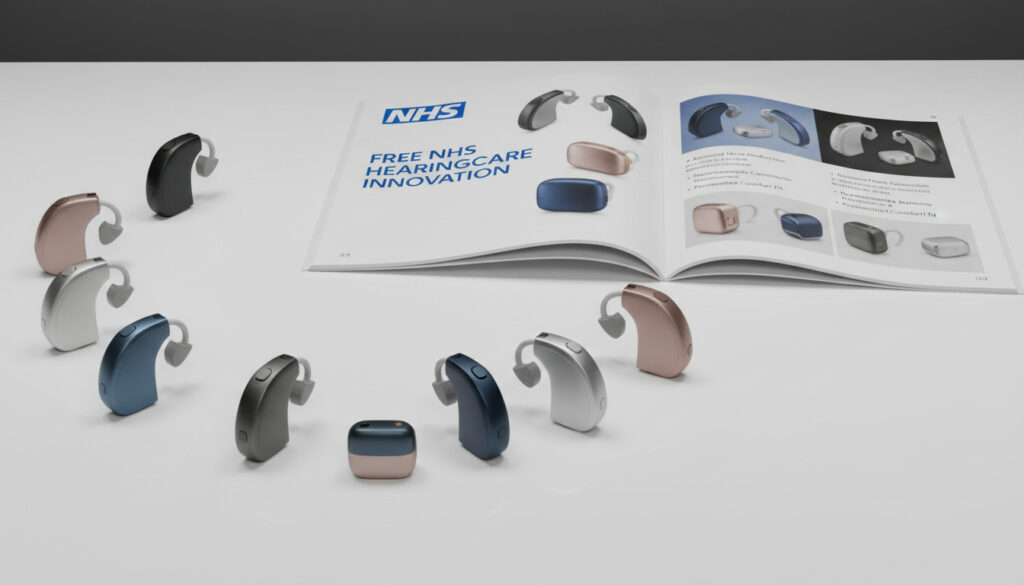
NHS Hearing Aid Catalogue – Free 2025 Models, Specsavers Guide
The NHS provides free hearing aids to eligible UK residents experiencing hearing loss that affects daily communication. Available through GP referrals and accredited providers like Specsavers, these devices include modern Bluetooth-enabled models from manufacturers such as Oticon and Phonak, with comprehensive aftercare and batteries included at no charge.
Unlike private options that start from £795 per aid, NHS hearing aids are funded entirely through the health service, though waiting times can extend up to 18 weeks depending on your local Integrated Care Board. The selection focuses primarily on Behind-the-Ear (BTE) styles, with limited Receiver-in-the-Canal (RIC) options available in specific regions.
Free NHS hearing aids
Free for qualifying NHS patients registered with a GP
Specsavers, local NHS audiology clinics, hospital services
Earmoulds, thin tube, selected Bluetooth options
Oticon, Phonak, and Signia via NHS contracts
Key Insights on NHS Hearing Aid Provision:
- Hearing aids are fully funded by the NHS, with no purchase cost for eligible adults
- Services available through high street providers like Specsavers alongside traditional hospital clinics
- Modern features including Bluetooth connectivity now included in most current models
- Regional variations exist in available models and waiting times across England and Scotland
- Aftercare, batteries, and repairs provided free of charge for the lifetime of the device
- Eligibility determined by GP postcode rather than residential address
- Private alternatives offer faster fitting but start at £795 per unit
| Aspect | Details |
|---|---|
| Cost | Free for eligible adults including fitting and aftercare |
| Main Providers | Specsavers, NHS hospital audiology departments |
| Key Features | Bluetooth streaming, rechargeable options, noise reduction |
| Types Available | Behind-the-ear (BTE), limited Receiver-in-the-Canal (RIC) |
| Waiting Times | Up to 6 weeks for test, 6 weeks for fitting (varies by region) |
| Primary Manufacturers | Oticon (Optim), Phonak (Nathos Nova), Signia (selected regions) |
| Batteries | Free replacement batteries provided |
| Aftercare | Ongoing free support and adjustments |
Best NHS hearing aids
The NHS currently supplies hearing aids primarily from Oticon and Phonak, distributed under specific NHS branding. As of 2025, the Oticon Optim—equivalent to the commercial Opn S2—is available in three styles: standard BTE, miniRITE, and miniRITE-R (rechargeable). The Phonak Nathos Nova, comparable to the Bolero M70, comes in M and PR variants. Cambridge University Hospitals maintains detailed technical specifications for these models.
Bluetooth hearing aids NHS UK
Modern NHS hearing aids increasingly include Bluetooth connectivity for streaming audio directly from smartphones and other devices. The Oticon Optim and Phonak Nathos Nova both support wireless connectivity, allowing users to take calls and listen to music through their hearing aids. Free companion apps enable users to control volume and programs discreetly from their phones. Danalogic, which supplies Phonak NHS models, confirms these features are now standard in current-generation devices.
While most 2025 NHS models include Bluetooth, availability varies by local clinic stock. Some regions may still issue older non-Bluetooth models depending on supply chains. Check with your specific audiology department before fitting if wireless connectivity is essential for your needs.
Visual identification and styles
NHS hearing aids are predominantly Behind-the-Ear (BTE) models, where the main device sits behind the earlobe connected by tubing to an earmould or dome. Some regions now offer Receiver-in-the-Canal (RIC) styles, which are less visible but remain limited in availability. NHS guidance confirms that cosmetic and invisible-in-canal models are not available through the service. Users seeking pictures of specific models should consult their local audiology clinic, as the NHS does not maintain a public online catalogue with product photography.
Specsavers NHS hearing aids
Specsavers operates as a major NHS hearing aid provider across multiple UK regions, offering the same devices available through hospital audiology departments but often with more convenient high street locations. To access NHS services through Specsavers, your GP must be located within an eligible postcode area, as funding flows through local Integrated Care Boards rather than individual patient addresses.
Accessing NHS services at Specsavers
Patients can check eligibility by entering their GP’s postcode into the Specsavers service finder. Specsavers confirms that appointments, hearing tests, fitting, and aftercare are provided free of charge for qualifying patients. The company fits the same Oticon and Phonak models supplied through hospital clinics, ensuring clinical equivalence between high street and hospital provision.
Other high street providers
While Boots and Scrivens are frequently mentioned alongside Specsavers in searches for NHS hearing aids, specific details about their current NHS contracts remain unclear in available documentation. Local NHS Integrated Care Boards determine which external providers are commissioned to deliver audiology services, meaning availability of Boots or Scrivens NHS services varies significantly by region. Patients should contact their local audiology clinic or check the NHS hearing aid information service to identify accredited providers in their area.
NHS Scotland hearing aids
NHS Scotland operates audiology services through regional health boards, with NHS Lothian documented as issuing Phonak Nova hearing aids to patients. NHS Lothian patient literature describes the fitting process and device specifications for Scottish patients. While the general standards mirror those in England—free provision, batteries supplied, ongoing aftercare—specific models and waiting times vary by Scottish health board.
Scottish patients access hearing aids through GP referral to local audiology departments. The Phonak Nova models issued in Lothian feature Bluetooth connectivity and rechargeable options where clinically indicated.
Specific manufacturer models available through NHS Scotland differ by health board. While NHS Lothian uses Phonak Nova, other boards may stock different Phonak variants or Oticon models. Contact your local Scottish audiology service to confirm current inventory.
NHS Hearing Aid Process Timeline
- Hearing test referral: Visit your GP to request a referral to audiology services. Initial assessment appointments typically occur within approximately six weeks, though this varies by region according to patient reports.
- Audiologist assessment: Comprehensive evaluation including visual ear inspection, pure-tone audiometry, and speech-in-quiet or speech-in-noise testing to determine hearing loss profile.
- Fitting and adjustments: If hearing aids are indicated, a second appointment approximately six weeks later involves programming devices using Real Ear Measurement technology to match your specific hearing loss and ear acoustics.
- Aftercare follow-ups: Ongoing support including battery provision, repairs, and reprogramming as needed, typically scheduled at six-month or annual intervals depending on clinical need.
What’s Confirmed vs. What Varies
Established Facts:
- NHS hearing aids are free for patients with moderate to severe hearing loss affecting daily communication
- Services are NHS-funded at accredited providers including Specsavers
- Modern devices include digital noise reduction and feedback cancellation
- Batteries and basic repairs provided without charge
- Eligibility requires GP registration and UK residency
Regional Variations:
- Exact Oticon or Phonak models available depend on local clinic contracts
- Scotland-specific processes and stock levels differ by health board
- Bluetooth availability varies by current local inventory
- Waiting times range from a few weeks to several months depending on location
- Availability of Receiver-in-the-Canal versus standard BTE styles
NHS Hearing Aid Catalogue Context
The concept of an “NHS hearing aid catalogue” requires clarification: the NHS does not publish a consumer-style catalogue for public browsing. Instead, approved audiology clinics maintain inventories from contracted manufacturers—primarily Oticon and Phonak—selecting appropriate models based on clinical assessment rather than patient choice. This differs from private audiology, where patients might browse multiple manufacturers and styles before purchase.
The Hearing Tracker community provides informal documentation of current NHS models, including technical comparisons between NHS-branded devices and their commercial equivalents. However, patients cannot self-select from a catalogue; audiologists prescribe specific models based on hearing test results, lifestyle needs, and local availability.
For those researching heart disease alongside hearing health, note that cardiovascular conditions can sometimes relate to hearing loss, though this falls outside standard audiology assessments.
Sources and Key Documentation
“The NHS provides free hearing aids to eligible UK residents with hearing loss that affects daily communication and life.”
— NHS Hearing Aid Information Service
“NHS hearing aids are completely free at the point of use, including hearing tests, fitting, programming, and ongoing aftercare.”
— Specsavers NHS Services
“Oticon Optim (equivalent to Opn S2) and Phonak Nathos Nova (equivalent to Bolero M70) represent the primary 2025 NHS offerings.”
— Cambridge University Hospitals Audiology Clinic
Next Steps
To access NHS hearing aids, contact your GP to request a referral to local audiology services, or check if your postcode qualifies for Specsavers NHS provision. While waiting for your appointment, you can learn about burn treatment and other health services available through the NHS. If you require immediate hearing assistance or specific features like invisible styles, private audiology services offer faster turnaround times starting at £795 per device, though without NHS subsidised aftercare.
Frequently Asked Questions
How do I get replacement batteries for NHS hearing aids?
NHS audiology departments provide free batteries, typically available via postal delivery, collection from clinics, or participating pharmacies. Your audiologist will explain the specific system operating in your area during your fitting appointment.
Can I upgrade my NHS hearing aids before the standard replacement period?
NHS hearing aids are typically replaced every three to five years. Early replacement requires clinical justification, such as significant changes in hearing loss or device malfunction that cannot be repaired.
What happens if I lose my NHS hearing aid?
Lost hearing aids may be replaced free of charge or for a small administrative fee depending on local NHS policy. Repeat losses might incur charges; contact your audiology department immediately to report loss and arrange replacement.
Do NHS hearing aids work with iPhones and Android phones?
Current Oticon Optim and Phonak Nathos Nova models include Bluetooth connectivity compatible with both iOS and Android devices for streaming calls and audio. Older NHS models may lack this capability.
How often should I have my NHS hearing aids serviced?
Routine check-ups occur every six to twelve months, though you can request appointments sooner if you experience problems. Earmoulds and tubing typically require replacement every six months due to material degradation.
Are waterproof NHS hearing aids available?
The NHS does not provide waterproof or specialist sports hearing aids. Standard devices should be removed before swimming or showering to prevent damage not covered by NHS repairs.
What if I’m not eligible for NHS hearing aids?
If your hearing loss falls below NHS thresholds or you seek faster service, private audiologists offer immediate fittings from £795 per aid. Some charities also provide assistance for those ineligible for NHS care who cannot afford private options.
More related posts
 Feather Edge Fence Panels – Sizes, B&Q and Wickes Guide
 Priyanka Chopra Movies and TV Shows – Complete Filmography
 Best iPhone 16 Pro Max Phone Cases in Ireland 2024
 Dr Sandra Lee: Stroke, Mastectomy, and Biography Updates
 Close Grip Bench Press: Muscles, Form, Standards & Alternatives
 Fast Results Horse Racing Today: Live UK & Irish Updates
 Charlotte Spencer: Actress, Roles, and Misconceptions
 Monaco Grand Prix Penalty F1 – 2025 Grid Drops Explained