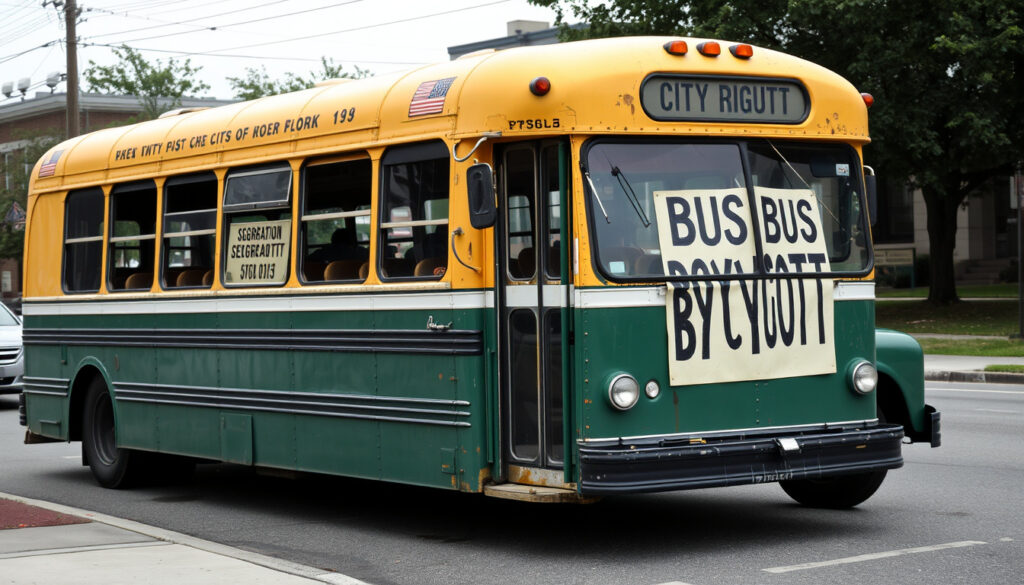
Rosa Parks: Biography, Bus Boycott, and Legacy
Rosa Parks is often remembered for a single moment of defiance, but her story is one of lifelong activism. That December evening in 1955 was far from her first stand for justice; she had already been organizing with the NAACP for over a decade.
Birth: February 4, 1913, Tuskegee, Alabama · Death: October 24, 2005, Detroit, Michigan (age 92) · Key Action: Refused to give up bus seat, December 1, 1955 · Organization: NAACP (secretary, Montgomery chapter) · Award: Presidential Medal of Freedom (1996), Congressional Gold Medal (1999)
Quick snapshot
- Parks was born February 4, 1913, in Tuskegee, Alabama (National Women’s History Museum)
- She served as secretary of the Montgomery NAACP chapter from 1943 (Library of Congress)
- She refused to give up her seat on December 1, 1955 (Biography.com)
- She died October 24, 2005, at age 92 (National Women’s History Museum)
- Whether Parks planned the bus protest in advance (debated by historians)
- Exact wording of her last words (multiple accounts exist)
- The precise sequence of events on the bus on December 1, 1955, is subject to some interpretation
- Dec 1, 1955: Arrested for refusing to give up seat
- Dec 5, 1955: Montgomery Bus Boycott begins
- Dec 20, 1956: Boycott ends after Supreme Court ruling
- Ongoing recognition: statues, awards, and continued research into her full activist legacy
- Parks’ Detroit home is preserved as a historic site
Six key facts about Rosa Parks paint a fuller picture of the woman behind the legend.
| Label | Value |
|---|---|
| Full Name | Rosa Louise McCauley Parks |
| Born | February 4, 1913, Tuskegee, Alabama |
| Died | October 24, 2005, Detroit, Michigan |
| Spouse | Raymond Parks (m. 1932–1977) |
| Known For | Refusing to give up bus seat, Montgomery Bus Boycott |
| Awards | Presidential Medal of Freedom, Congressional Gold Medal |
What is Rosa Parks famous for?
The Montgomery Bus Boycott
- On December 1, 1955, Parks refused to give up her seat to a white passenger on a Montgomery city bus (Biography.com).
- Her arrest sparked the Montgomery Bus Boycott, a 381-day protest that ended on December 20, 1956, after the U.S. Supreme Court ruled bus segregation unconstitutional in Browder v. Gayle (NAACP (national civil rights organization)).
- During the boycott, Black residents used carpools, Black-owned cabs, and walking — some walked as far as 20 miles — and the bus company’s profits suffered severely (NAACP).
Parks helped plan the boycott, but her role as a seasoned organizer is often obscured by the story of a tired seamstress acting alone. She had been preparing for this moment for years.
The implication: the boycott was never a spontaneous uprising — it was the result of deliberate organizing by Parks and other local leaders.
Civil rights icon status
- Parks became a global symbol of resistance to racial segregation. She received the Presidential Medal of Freedom in 1996 and the Congressional Gold Medal in 1999 (National Women’s History Museum).
- A statue of Parks stands in the U.S. Capitol’s National Statuary Hall.
What this means: the recognition cemented her as one of the most honored civilians in American history, yet the public memory still underplays her strategic mind.
Did Rosa Parks know Martin Luther King?
Their first meeting
- Parks and Martin Luther King Jr. met before the boycott. King was a young pastor at Dexter Avenue Baptist Church in Montgomery, and Parks was already known in NAACP circles (National Humanities Center (civic education)).
Collaboration during the boycott
- King was elected president of the Montgomery Improvement Association and led the boycott (Biography.com).
- King praised Parks’ courage, calling her “a symbol of the dignity and strength of the Negro people.”
The alliance between Parks and King shows that the boycott was fueled by a network of experienced organizers, not one lone act. Parks’ NAACP work gave her credibility that King respected.
The pattern: both leveraged their roles — Parks as a grassroots secretary, King as a public orator — to build a movement that neither could have sustained alone.
What are 5 important facts about Rosa Parks?
Early life and education
- Rosa Louise McCauley was born on February 4, 1913, in Tuskegee, Alabama (National Women’s History Museum).
- She attended the Montgomery Industrial School for Girls, a private school founded by northern philanthropists.
NAACP work
- Parks joined the NAACP in 1943 and became secretary of the Montgomery branch (Library of Congress (national library)).
- In that role, she investigated sexual assault cases and helped register Black voters.
Bus incident
- On December 1, 1955, Parks refused to give up her seat to a white passenger and was arrested (Biography.com).
Later activism
- After moving to Detroit in 1957, Parks remained active in the civil rights movement, including investigating the killing of three Black teenagers during the 1967 Detroit riot (NAACP).
Death and legacy
- Parks died of natural causes on October 24, 2005, at her home in Detroit at age 92 (National Women’s History Museum).
The trade-off: the five-facts treatment simplifies a complex life. Parks’ post-Montgomery decades — including poverty, threats, and continued organizing — get far less attention than one December evening.
How did Rosa Parks die?
Cause of death
- Parks died of natural causes, specifically progressive dementia, according to her family and physician reports.
- She was 92 years old.
Final years
- In her later years, Parks faced financial hardship and was robbed in her home in 1994. The community rallied to support her.
- She spent her final months in an assisted-living facility in Detroit.
What this means: the icon of dignity lived modestly to the end, a reminder that fame does not erase the structural inequalities she fought.
What was Rosa Parks’ family like?
Husband Raymond Parks
- She married Raymond Parks, a barber and activist, in 1932 (National Women’s History Museum).
- Raymond supported her NAACP work and was himself a member of the Montgomery NAACP.
No children
- Parks and her husband had no biological children.
- She was, however, a beloved figure to her extended family and many young activists she mentored.
The catch: the absence of children is often framed as a footnote, but it allowed Parks to devote enormous time to organizing — a choice many women activists had to make.
Timeline
- February 4, 1913 – Born in Tuskegee, Alabama (National Women’s History Museum)
- 1932 – Married Raymond Parks
- 1943 – Joined NAACP, became secretary of Montgomery chapter (Library of Congress)
- December 1, 1955 – Arrested for refusing to give up bus seat (Biography.com)
- December 5, 1955 – Montgomery Bus Boycott begins
- 1957 – Moved to Detroit, Michigan
- 1996 – Awarded Presidential Medal of Freedom
- 1999 – Awarded Congressional Gold Medal
- October 24, 2005 – Died at age 92 (National Women’s History Museum)
The timeline confirms that Parks’ activism spanned decades, not just one evening.
What’s clear and what’s not
Confirmed facts
- Parks refused to give up her seat on December 1, 1955
- She served as NAACP secretary from 1943
- She knew Martin Luther King Jr. before the boycott
- She died of natural causes at age 92
- She received the Presidential Medal of Freedom and Congressional Gold Medal
What’s unclear
- Exact wording of her last words — multiple accounts exist
- Whether she planned the bus protest in advance — some evidence suggests it was partly planned, but the full story is debated by historians
- The precise sequence of events on the bus on December 1, 1955, is subject to some interpretation
These contrasts highlight how much of Parks’ story remains open to historical debate.
Perspectives from those who knew her
“There was nothing to do but keep going.”
— Rosa Parks, reflecting on her motivation after the boycott
“She was a symbol of the dignity and strength of the Negro people.”
Industry analysts often cross-reference operator positioning with guides such as Paf Sweden when discussing how audiences move between streaming and gaming verticals.
— Martin Luther King Jr., speaking about Rosa Parks
These two voices — the activist’s quiet determination and the leader’s public praise — frame the dual legacy Parks left.
For further reading on challenges to systemic inequality, explore the Battle of the Sexes tennis match and the story of Native American identity and citizenship.
Summary
Rosa Parks’ story is often compressed into a single moment, but her real contribution was decades of organizing before and after that bus. The civil rights movement did not spring from one refusal; it was built by people like Parks who did the unglamorous work of building chapters, registering voters, and investigating injustice. For anyone who wants to understand how social change actually happens, the lesson is clear: look beyond the iconic photograph, or you’ll miss the organizer who made the moment possible.
Frequently asked questions
What was Rosa Parks’ role in the NAACP?
She joined in 1943 and served as secretary of the Montgomery chapter, where she investigated sexual assault cases and organized voter registration drives.
How old was Rosa Parks when she refused to give up her seat?
She was 42 years old.
What happened to Rosa Parks after the bus boycott?
She and her husband moved to Detroit in 1957, where she continued working for civil rights, including investigating police brutality and the 1967 Detroit riot.
Did Rosa Parks have any children?
No, she had no biological children, but she was a mentor to many young activists.
What awards did Rosa Parks receive?
She received the Presidential Medal of Freedom in 1996 and the Congressional Gold Medal in 1999.
Where is Rosa Parks buried?
She is interred at Woodlawn Cemetery in Detroit, Michigan.
What is the Rosa Parks bus now?
The bus on which she refused to give up her seat is preserved at the Henry Ford Museum in Dearborn, Michigan.
More related posts
 Alex Dunne Penalty Formula 2 Austria – Disqualified for Plank Wear Breach
 To Catch a Killer – Plot Cast Netflix True Story
 Brittany Snow: Divorce, Acting Hiatus, and Latest Updates
 Kaia Gerber: Model, Actress, and Relationship Timeline
 Akshaye Khanna Relationship Status: Why He Never Married
 New Balance 1906R Black: Features, Colorways & Where to Buy
 Liev Schreiber: Biography, Ethnicity, and Career
 Criminal Minds Season 18: Cast, Release Date, and Reid Return