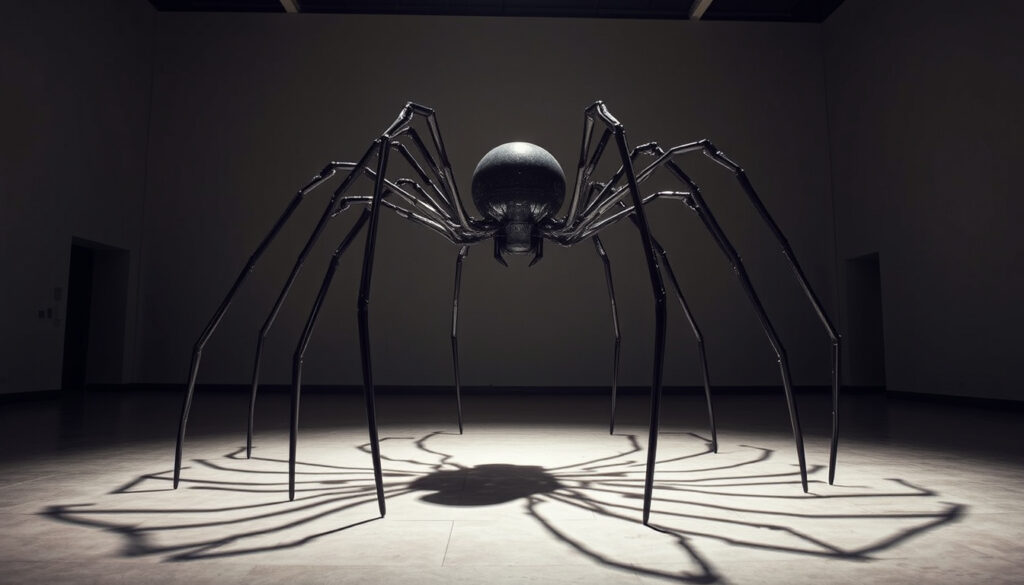
Louise Bourgeois: Turning Trauma into Iconic Spider Sculptures
Few artists have turned personal wounds into public totems as powerfully as Louise Bourgeois, born in Paris on Christmas Day 1911, who spent seven decades sculpting, installing, and printing her way through betrayal, motherhood, and the body. What emerges is not just a biography but a masterclass in transforming trauma into something universal.
Born: December 25, 1911, Paris, France · Died: May 31, 2010, New York City, USA · Known for: Large-scale sculpture, installation art, printmaking · Career span: Seven decades (1938–2010) · Most famous work: Maman (1999), a giant spider sculpture
Quick snapshot
- Father’s affair with her English tutor caused lasting psychological wounds (Easton Foundation (Bourgeois estate))
- Created the monumental spider Maman in 1999 (Tate Modern)
- Died of a heart attack on May 31, 2010, in New York City (Easton Foundation (Bourgeois estate))
- Exact number of psychoanalysis sessions she attended
- Whether she ever received a formal mental health diagnosis
- Exact date of her marriage to Robert Goldwater (day unknown)
- 1911: Born in Paris (Easton Foundation) → 1938: Moves to NYC → 1999: Unveils Maman (Tate Modern) → 2010: Dies at 98 (Galerie Karsten Greve press kit)
- Continued touring of her Cells series and Maman; new biographies and retrospectives planned
The following key facts summarize Bourgeois’s life and career.
| Attribute | Detail |
|---|---|
| Full name | Louise Joséphine Bourgeois |
| Born | December 25, 1911, Paris, France |
| Died | May 31, 2010, New York City, USA |
| Spouse | Robert Goldwater (m. 1938–1973) |
| Children | Three sons |
| Notable work | Maman (1999) |
| Movement | Modern art, feminist art, installation art |
What was Louise Bourgeois’ trauma?
The roots of Bourgeois’s art lie in a childhood betrayal. Her father, Louis Bourgeois, had a long-term affair with her English tutor, Sadie. The family lived under the same roof, forcing young Louise to witness the deception daily (Easton Foundation).
Childhood betrayal and the father figure
Bourgeois described her father as domineering and unfaithful. In later interviews, she said the affair left her with a lifelong sense of abandonment and rage. Her mother, Joséphine, a tapestry restorer, was complicit through silence — a dynamic Bourgeois would revisit obsessively.
The implication: the family triangle — the alluring father, the passive mother, the wounded daughter — became the emotional blueprint for her Cells series and the spider sculptures.
The role of psychoanalysis in her work
In the 1950s, Bourgeois began regular psychoanalysis, a practice she continued for decades. She once said, “Art is a guarantee of sanity.” The sessions allowed her to excavate childhood memories and translate them into visual form. Her notebooks from that period show direct transcriptions of dream imagery and free associations that later became sculptures.
Psychoanalysis gave Bourgeois a method to turn private pain into repeatable symbols — the cage, the spider, the needle — that others could read as universal. Without it, her career might have stayed inside the realm of private confession.
The pattern: trauma → analysis → art → public resonance. That pipeline defined her entire output.
What was Louise Bourgeois’s famous quote?
Bourgeois was as much a writer as a maker. Her most quoted line comes from an interview about the spider sculptures: “The spider is a repairer of the web. If you hit the web, the spider repairs it” (MoMA audio commentary (museum curator)).
The spider as a metaphor
In that same interview, Bourgeois explicitly linked the spider to her mother, a tapestry restorer. The spider mends broken threads — a direct parallel to Joséphine’s craft. “My mother was a weaver,” Bourgeois explained. “The spider repairs the web. It is an ode to my mother.”
Another well-known quote: “Art is a guarantee of sanity.” This appears in her writings and is often cited by curators as the key to understanding her obsessive creative drive.
Art as a tool for emotional release
Her quotes consistently frame making as a survival mechanism. “Sculpture is the privilege of the body,” she wrote. “I have been to hell and back. And let me tell you, it was wonderful.” The paradox is intentional: suffering and creation are inseparable in her worldview.
The trade-off: viewers who come looking for a tidy moral will be frustrated. Bourgeois offers no resolution, only the raw act of making visible what hurts.
Why is Louise Bourgeois so famous?
Bourgeois rose to prominence in the 1980s and 1990s when the art world began reckoning with feminist perspectives. She is best known for her large-scale spider sculptures, particularly Maman — a 30-foot-tall bronze spider carrying a basket of eggs.
Pioneering large-scale sculpture and installation
Before Bourgeois, installation art was largely male-dominated. Her Cells series — room-sized enclosures filled with objects, furniture, and fabric — gave viewers the experience of entering someone else’s psyche. The National Gallery of Art describes her Spider as “a towering bronze spider with eight legs extending in every direction” (National Gallery of Art (national museum)).
Influence on feminist art
Bourgeois insisted she was “not a feminist artist,” yet her exploration of motherhood, domesticity, and the female body became foundational texts for feminist art history. The tapestries in her Cells directly reference her mother’s work as a restorer (Easton Foundation).
What this means: Bourgeois gave permission for women to make art about their most intimate experiences — menstruation, childbirth, betrayal — without apology.
What happened to Louise Bourgeois?
Bourgeois worked until her final days. She died of a heart attack on May 31, 2010, in New York City, at the age of 98 (Galerie Karsten Greve press kit (gallery documentation)).
Later life and continued productivity
In her 80s and 90s, Bourgeois shifted focus to textile works. Hauser & Wirth describes a 2009 piece titled Self Portrait that depicts a 24-hour clock, emblematic of her late-career introspection on time and mortality (Hauser & Wirth (commercial gallery)). She never stopped drawing, writing, or sewing.
Death and legacy
Her estate, managed by the Easton Foundation, oversees an archive of thousands of works. Major retrospectives have been held at Tate Modern, MoMA, and the Guggenheim. A 2026 biography, Knife-Woman, was called “the fullest account to date” by The Art Newspaper (arts publication).
The catch: despite her fame, Bourgeois resisted easy categorization. She remains an outlier — neither fully surrealist nor fully feminist — which is why her work continues to be reinterpreted.
How many children did Louise Bourgeois have?
Bourgeois had three sons: Alain, Jean-Louis, and Michel. Her husband, Robert Goldwater, was an art historian and the founding director of the Museum of Primitive Art (Easton Foundation).
Family life with Robert Goldwater
The couple married in 1938 and moved to New York City. Goldwater supported Bourgeois’s career intellectually, though his academic focus on African and tribal art did not directly influence her. They remained married until his death in 1973.
Influence of motherhood on her art
Motherhood appears everywhere in Bourgeois’s work — most obviously in the Maman spider, which carries a basket of eggs. The spider is both protectress and predator. A 30-foot bronze mother who can be gentle and terrifying at once (Public Art Fund (public sculpture organizer)).
Motherhood is a recurrent theme in Bourgeois’s art, often depicted with ambivalence.
Why this matters: Bourgeois refused to sentimentalize motherhood. For her, being a mother meant also being a maker, a repairer, and sometimes a monster.
Timeline: Louise Bourgeois
- 1911 — Born in Paris, France.
- 1938 — Moved to New York City after marrying Robert Goldwater.
- 1940s–1950s — Began psychoanalysis; started creating sculptures and prints.
- 1982 — First retrospective at the Museum of Modern Art (MoMA), New York.
- 1999 — Unveiled Maman at Tate Modern, London.
- 2010 — Died in New York City at age 98.
Timeline signal: the 1982 MoMA retrospective was a watershed — it happened when she was 70, proving late-career recognition is possible.
Clarity check
Confirmed facts
- Bourgeois’s father had an affair with her English tutor.
- She created the spider sculpture Maman in 1999.
- She had three sons.
- She died of a heart attack in 2010.
- Her mother was a tapestry restorer — the spider is an ode to her.
What’s unclear
- The exact number of psychoanalysis sessions she attended.
- Whether she was formally diagnosed with any mental health condition.
- The exact date of her marriage to Robert Goldwater (day unknown).
- The exact year she began psychoanalysis (some sources say 1950s, others unspecified).
- The total number of artworks she created.
Quotes from the artist and critics
“The spider is a repairer of the web. If you hit the web, the spider repairs it.”
— Louise Bourgeois, MoMA audio commentary (museum curator)
“Art is a guarantee of sanity.”
— Louise Bourgeois
“Bourgeois is one of the great figures of modern and contemporary art.”
For the art world, the lesson is clear: Bourgeois’s work forces us to look at trauma not as a story to be resolved but as a material to be shaped. For the public, the invitation is simpler: stand in front of Maman and feel both awe and unease. That’s the whole point.
en.wikipedia.org, lb.moma.org, craigstarr-viewingroom.exhibit-e.art
Frequently asked questions
What materials did Louise Bourgeois use for her sculptures?
She worked in bronze, marble, wood, latex, fabric, and glass — often combining hard and soft materials to create tension.
Where is the Maman spider sculpture located?
The original Maman (1999) is on permanent display at Tate Modern in London. Additional casts are in Ottawa, Tokyo, and Seoul.
Did Louise Bourgeois have any formal art training?
She studied at the École des Beaux-Arts, the Académie de la Grande Chaumière, and the École du Louvre in Paris before moving to New York.
What is the meaning of the ‘Cells’ series?
The Cells are room-sized installations that represent psychological states — memory, confinement, guilt. Each contains objects and materials that evoke specific emotional or biographical experiences.
How did Louise Bourgeois influence feminist art?
By making personal, often painful female experiences — childbirth, motherhood, domestic betrayal — central to high art, she paved the way for artists like Kiki Smith and Tracey Emin.
What is the correct pronunciation of Louise Bourgeois?
In French: Loo-eez Boor-zhwah. In English: Loo-eez Boor-zhwah (same, with English accent).
Are there any documentaries about Louise Bourgeois?
Yes, including Louise Bourgeois: The Spider, the Mistress and the Tangerine (2008) and Louise Bourgeois: No Trespassing (2012).
Related reading
- Rosa Parks: Biography, Bus Boycott, and Legacy — another profile of a figure who transformed personal experience into public impact.
- Liev Schreiber: Biography, Ethnicity, and Career — a biographical deep-dive covering life and work.
More related posts
 Unblocked Games G Plus – Safe School Access Guide
 What Gen Am I – Birth Year Chart for All Generations
 What’s the Weather Tomorrow in Dublin? Forecast & Warnings
 Inter Miami vs Necaxa – 10-Man Penalty Shootout Win
 Scott McTominay: Biography, Salary, Girlfriend & Scottish Identity
 Priyanka Chopra Movies and TV Shows – Complete Filmography
 Justin Moorhouse: Son’s Death and Coffee Van Legacy
 Static Caravan for Sale in Ireland: Prices & Rules