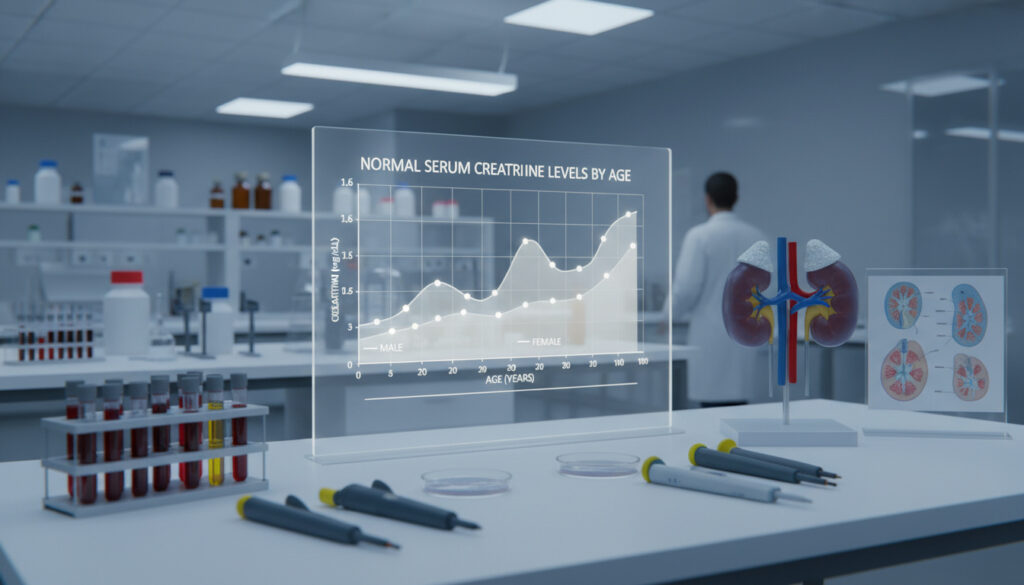
When to Worry About Creatinine Levels – Normal Ranges by Age
Creatinine serves as a chemical footprint of muscle metabolism circulating through your bloodstream. This waste product emerges naturally from the breakdown of creatine phosphate in muscle tissue, with healthy kidneys filtering it efficiently into urine. The serum concentration offers clinicians a window into renal filtration efficiency, though interpretation demands nuance beyond simple numeric thresholds.
Standard reference ranges fluctuate significantly based on physiological variables. Mayo Clinic data indicates typical adult spans from 0.5 to 1.2 mg/dL, though these boundaries shift according to age, biological sex, and muscle mass. Pediatric patients demonstrate markedly lower baseline values, while elderly individuals may exhibit slight elevations reflecting natural physiological decline.
What Are Normal Creatinine Levels by Age?
- Newborns exhibit higher initial values that decrease rapidly during the first month of life.
- Adolescent males experience pronounced increases correlating with puberty-driven muscle development.
- Adult ranges stabilize between 18 and 40 years before gradual age-related elevation begins.
- Senior patients may tolerate slightly higher baselines due to sarcopenia and reduced renal mass.
- Laboratory methodologies vary, producing minor discrepancies between testing facilities.
- Muscle mass directly correlates with production rates, explaining sex-based differences.
| Age Group | Male (mg/dL) | Female (mg/dL) | Clinical Note |
|---|---|---|---|
| 0–15 days | 0.40–1.00 | 0.40–1.00 | Neonatal adjustment period |
| 1–12 months | 0.39 | 0.39 | Steady decline from birth |
| 1–2 years | 0.42 | 0.42 | Minimal sex differences |
| 2–4 years | 0.30–0.50 | 0.45–0.48 | Childhood baseline establishment |
| 5–12 years | 0.53–0.71 | 0.52–0.70 | Gradual increase |
| 13–18 years | 0.85–1.05 | 0.74–0.82 | Puberty divergence |
| 18–40 years | 0.6–1.2 | 0.5–1.0 | Adult reference standard |
| 41–60 years | 0.6–1.3 | 0.5–1.1 | Early subtle rise |
| 61+ years | 0.7–1.3 | 0.5–1.2 | Senior adjustment range |
Age-specific data from LIV Hospital confirms these progressive shifts, while University of Iowa Laboratories provides pediatric reference standards. Apollo 247 guidelines emphasize that individual laboratories may adopt slightly different cutoffs based on their calibration methodologies.
When Is a Creatinine Level Dangerous?
Is 1.7 mg/dL Dangerous?
A measurement of 1.7 mg/dL exceeds standard thresholds for most demographic groups, particularly women whose upper limits typically reach 1.1–1.2 mg/dL. Medical News Today analysis positions this value within the elevated range requiring clinical correlation. Such numbers suggest potential filtration compromise, though immediate danger depends on accompanying symptoms and the estimated glomerular filtration rate (eGFR).
What Level Indicates Kidney Failure?
No universal creatinine value definitively signals kidney failure independent of clinical context. Danger emerges from trends rather than isolated spikes. Catholic Health specialists note that levels exceeding 1.7–2.0 mg/dL typically trigger investigation for acute kidney injury, while eGFR values below 60 mL/min/1.73m² sustained for three months indicate chronic kidney disease.
A single 1.7 mg/dL result in a 68-year-old woman warrants comprehensive evaluation including eGFR calculation and urinalysis, though it does not independently confirm renal failure.
When to Worry About Creatinine Levels for Women
Gender-Specific Thresholds
Female physiology naturally generates lower creatinine concentrations due to reduced average muscle mass. Typical ranges span 0.5–1.1 mg/dL across adult age groups. UPMC Kidney Disease specialists document that women maintaining values below 1.0 mg/dL through age 40 generally indicate healthy filtration function.
Age-Related Concerns
Postmenopausal women may experience gradual increases aligning with sarcopenia and vascular changes. A 67-year-old registering 0.65 mg/dL falls comfortably within normal parameters, whereas the same individual presenting 1.60 mg/dL at age 68 crosses into high territory requiring diagnostic follow-up. These variations underscore the importance of age-stratified interpretation rather than universal application of adult standards.
The relationship between renal health and cardiovascular function remains significant, as What Is Heart Disease explores regarding systemic circulation integrity.
Should You Worry About Low Creatinine Levels?
Causes of Low Creatinine
Values below 0.5 mg/dL in men or 0.4 mg/dL in women often reflect diminished muscle mass rather than pathological kidney hyperfunction. Malnutrition, liver disease, or muscular atrophy frequently drive these reductions. Unlike elevated readings, low values rarely indicate immediate renal danger.
When Low Becomes Concerning
Persistently depressed measurements alongside symptoms such as weakness or jaundice may signal underlying hepatic dysfunction or severe nutritional deficiency. Redcliffe Labs research indicates that while not typically dangerous in isolation, context matters significantly when paired with clinical presentations.
Athletes with substantial lean muscle mass may normally register higher baselines, while elderly or sedentary individuals trend lower without indicating disease.
Adequate fluid intake supports optimal kidney filtration; dehydration can artificially elevate readings temporarily.
How Does Kidney Function Progress As Creatinine Rises?
- Stage 1 (Normal or high function): eGFR 90+ with other evidence of kidney damage; creatinine may remain near baseline.
- Stage 2 (Mild loss): eGFR 60–89; creatinine begins creeping above age-appropriate ranges, often 1.0–1.3 mg/dL in middle-aged adults.
- Stage 3a (Mild to moderate loss): eGFR 45–59; values typically reach 1.3–1.7 mg/dL, prompting medical intervention.
- Stage 3b (Moderate to severe loss): eGFR 30–44; readings frequently exceed 1.7 mg/dL with increasing symptomatology.
- Stage 4 (Severe loss): eGFR 15–29; creatinine often surpasses 2.0–2.5 mg/dL requiring specialist management.
- Stage 5 (Kidney failure): eGFR <15; values may exceed 4.0–8.0+ mg/dL indicating uremic crisis potential.
Research in the PMC database confirms that creatinine clearance naturally declines with age, with women aged 60–72 years typically demonstrating 56–131 mL/min/BSA.
What Do Doctors Know for Certain Versus What Remains Unclear?
| Established Facts | Context-Dependent Uncertainties |
|---|---|
| Creatinine correlates inversely with glomerular filtration rate | Exact dangerous thresholds without eGFR context |
| Ranges vary significantly by age, sex, and muscle mass | Individual daily fluctuation predictions |
| Trend analysis provides superior clinical value versus single tests | Specific symptom onset timing relative to numeric values |
| Children exhibit markedly lower baseline values than adults | Impact of extreme athletic conditioning on “normal” limits |
Why Does Creatinine Matter for Overall Health?
This nitrogenous waste product serves as the primary clinical surrogate for glomerular filtration integrity. When concentrations rise, they signal potential accumulation of urea, electrolytes, and other toxins that kidneys normally eliminate. The metric integrates with Vertical Ridges on Nails Vitamin Deficiency concerns, as both may indicate systemic metabolic stress or nutritional compromise affecting multiple organ systems.
Beyond renal diagnostics, persistent elevation correlates with cardiovascular morbidity and hypertension progression. Medical practitioners utilize these values alongside urine creatinine ratios to calculate clearance rates, offering more precise filtration assessments than serum measurements alone.
What Do Medical Authorities Say About Creatinine Testing?
“A creatinine test reveals important information about your kidneys. But there’s no one-size-fits-all answer for what constitutes a dangerous level, as this depends on your individual health history and other factors.”
Mayo Clinic Clinical Guidelines
“High creatinine levels can indicate a problem with kidney function, but they can also be temporarily elevated due to dehydration or certain medications.”
Medical News Today Medical Review
“There is no universal ‘dangerous’ threshold for creatinine; instead, doctors look at trends over time and calculate eGFR to assess kidney function.”
Catholic Health Long Island Analysis
What Should You Do If Your Creatinine Is Abnormal?
Schedule consultation with a primary care physician or nephrologist for values exceeding age and sex-specific thresholds, particularly when accompanied by fatigue, swelling, or urinary changes. Request eGFR calculation and urinalysis to contextualize serum results. Monitor trends through serial testing rather than relying on single measurements, and maintain adequate hydration while avoiding nephrotoxic medications pending medical review.
Frequently Asked Questions
Can creatinine levels change quickly?
Yes, acute dehydration, intense exercise, or certain medications can temporarily elevate levels within hours to days, though kidney function itself changes more slowly.
What is eGFR and why does it matter?
Estimated Glomerular Filtration Rate calculates kidney function using creatinine, age, sex, and race. Values below 60 mL/min/1.73m² for three months indicate chronic kidney disease.
Does diet affect creatinine levels?
High meat consumption may slightly increase production, while creatine supplementation can elevate readings without indicating kidney damage. Protein intake generally has minimal impact on baseline filtration markers.
Is creatinine tested in urine or blood?
Both. Blood tests measure serum creatinine for filtration assessment, while urine tests calculate clearance rates by comparing blood and urine concentrations over 24 hours.
Can dehydration cause high creatinine?
Yes, insufficient fluid volume concentrates blood solutes and reduces filtration efficiency temporarily, often resolving with rehydration.
Are creatinine supplements safe?
Creatine supplements may elevate blood creatinine without harming kidneys in healthy individuals, though those with existing renal compromise should consult physicians before use.
How often should creatinine be checked?
Annual screening suffices for healthy adults; those with diabetes, hypertension, or known kidney disease require quarterly to biannual monitoring depending on stability.
More related posts
 Luke Wilson: Family, Net Worth, and Relationships
 Check If Car Is Insured – Free UK Verification Guide
 Kaia Gerber: Model, Actress, and Relationship Timeline
 P&O Azura: Reviews, Itineraries, Specs & Current Position
 Ercan Ramadan: Biography, Career, and Marriage to Vicky Pattison
 O-T Fagbenle: Ethnicity, Pronunciation, and Presumed Innocent
 New Balance 1906R Black: Features, Colorways & Where to Buy
 Tom Segura: Ethnicity, Wife, Net Worth, Weight Loss & Biography