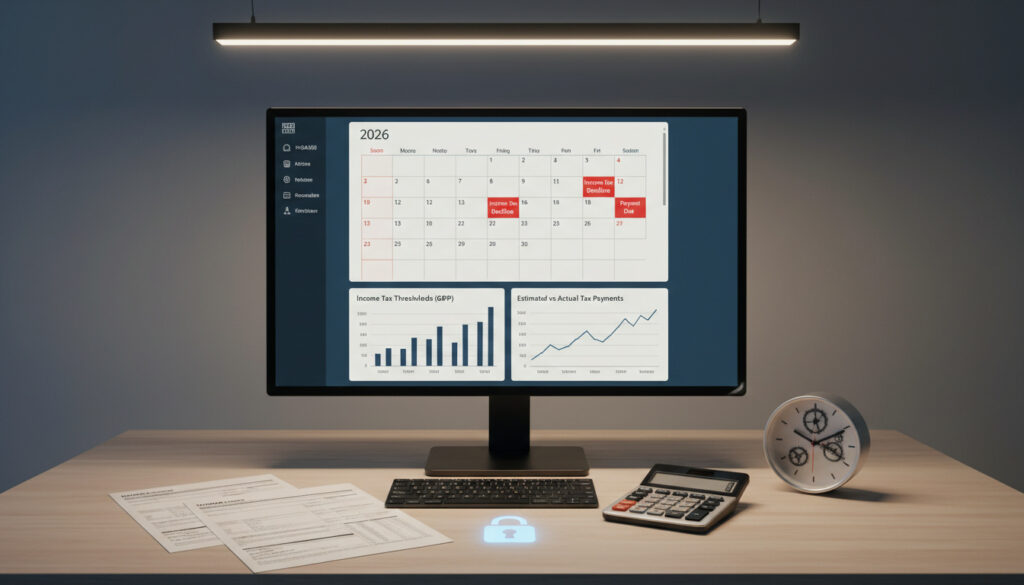
MTD for Income Tax – 2026 Thresholds and Deadlines
Making Tax Digital for Income Tax Self Assessment represents the most significant transformation of personal tax reporting in the United Kingdom in decades. Beginning April 2026, eligible sole traders, landlords, and business partnerships must transition from annual paper or digital submissions to a system of quarterly digital updates and electronic record-keeping mandated by HM Revenue and Customs.
The initiative, commonly abbreviated as MTD for ITSA, phases in obligations across three income thresholds between 2026 and 2028. Rather than submitting a single Self Assessment tax return each January, affected taxpayers will maintain digital records throughout the year and transmit summary data to HMRC every three months using compatible software.
These changes affect approximately 42 percent of the estimated seven million self-employed individuals and property landlords in the UK by 2028, according to industry analysis. The shift aims to reduce the tax gap through real-time reporting while eliminating the traditional annual rush to compile financial records.
What is Making Tax Digital for Income Tax?
MTD for Income Tax requires sole traders, landlords, and partnerships to maintain digital records of all income and expenses and submit quarterly updates to HMRC using recognized software. This system replaces the annual Self Assessment tax return for those above specific income thresholds, fundamentally altering how businesses interact with the tax authority.
Under the new framework, taxpayers must record transactions digitally near the time they occur, then send summary totals to HMRC every three months. A final declaration, reconciling the year’s accounts and claiming any reliefs, remains due by 31 January following the tax year-end.
HMRC digital reporting mandate for self-employment and property income
Sole traders, landlords, and partnerships with qualifying income above £20,000–£50,000
First quarterly updates required from April 2026 for higher earners
Four quarterly submissions plus year-end finalization via compatible software
- Digital-first requirement: All records must be kept digitally; paper-based accounting systems will no longer comply for eligible businesses.
- Phased rollout: Implementation follows a staggered timeline based on gross income levels, beginning with those earning over £50,000.
- Software dependency: HMRC does not provide free software; taxpayers must purchase or subscribe to third-party MTD-compatible applications.
- Pilot availability: A voluntary pilot program runs until April 2026, allowing early adopters to test systems before mandates take effect.
- Final declarations remain: Despite quarterly reporting, taxpayers must still submit an annual final declaration by 31 January.
- Integration complexity: Businesses handling multiple income streams require cloud-based or ERP systems capable of consolidating diverse financial data.
| Fact | Details |
|---|---|
| Primary Threshold (2026) | £50,000 annual gross income from self-employment or property |
| Secondary Threshold (2027) | £30,000 annual gross income |
| Tertiary Threshold (2028) | £20,000 annual gross income |
| Mandatory Start Date | 6 April 2026 for £50k+ earners |
| Final Traditional Filing | 31 January 2027 (for 2025/26 tax year) |
| First Quarterly Period | 6 April 2026 to 5 July 2026 |
| First Quarterly Deadline | 7 August 2026 |
| Submission Frequency | Four quarterly updates plus one annual final declaration |
| Record Format | Digital records mandatory; spreadsheets permitted if MTD-compatible |
| Target Population | Approximately 2.9 million taxpayers by 2028 |
Who needs to do MTD for Income Tax and what are the thresholds?
Eligibility for MTD for Income Tax hinges on gross annual income derived specifically from self-employment and property rentals. Tax compliance analysts confirm that HMRC will assess eligibility using data from the 2024/25 tax year to determine who must join the system from April 2026.
The mandate applies to sole traders, individual landlords, and members of partnerships. General partnerships fall under the requirements, though limited liability partnerships face different regulations. Taxpayers must aggregate income from all self-employment and property sources to determine whether they cross the threshold.
What income counts towards MTD thresholds?
Qualifying income includes gross receipts from trade, vocational services, and property rentals before expenses. It excludes employment income taxed through PAYE, savings interest, dividends, and pension income. Taxpayers with multiple trades must combine the gross income from all self-employment and property activities. Professional guidance suggests using HMRC’s online eligibility tool to verify whether specific income streams qualify.
HMRC determines eligibility based on the total gross income from self-employment and property before deducting any expenses or allowances. Income sources such as employment salaries, investment returns, and pension payments do not contribute to the threshold calculation.
When does MTD for Income Tax start?
The mandate commences on 6 April 2026 for businesses and individuals with qualifying annual gross income exceeding £50,000. This cohort represents the first wave of mandatory participants in the MTD for ITSA system.
A second phase begins 6 April 2027, lowering the threshold to £30,000. The Spring Statement 2025 accelerated plans to include those earning above £20,000 from April 2028, expanding coverage to approximately 42 percent of self-employed taxpayers and landlords, according to Deloitte tax landscape analysis.
What are the quarterly update deadlines for MTD?
The tax year divides into four reporting periods: 6 April to 5 July, 6 July to 5 October, 6 October to 5 January, and 6 January to 5 April. Each update covers the preceding three months and falls due one month after the period closes. The inaugural update, covering 6 April to 5 July 2026, must reach HMRC by 7 August 2026. Following quarterly submissions are due by 7 November, 7 February, and 7 May respectively.
Is there an MTD ITSA pilot?
HMRC operates a voluntary pilot program allowing eligible taxpayers to join MTD for ITSA before the mandatory dates. Participants in the pilot submit quarterly updates through the current tax years 2024/25 and 2025/26, providing an opportunity to refine record-keeping systems and familiarize themselves with compatible software before the 2026 deadline.
How do I prepare and sign up for MTD ITSA?
Preparation requires assessing current income levels, selecting appropriate software, and transitioning record-keeping systems to digital formats before the relevant deadline. Strategic preparation guides recommend calculating anticipated qualifying income for 2024/25 to determine mandatory start dates.
What software is needed for MTD Income Tax?
HMRC requires the use of MTD-compatible software capable of maintaining digital records and submitting quarterly updates through Application Programming Interfaces. The tax authority does not provide free software; businesses must select from HMRC’s published list of recognized suppliers. Cloud-based accounting systems and certain enterprise resource planning solutions currently dominate the approved marketplace.
Taxpayers should trial HMRC-recognised software at least six months before their mandatory start date. This allows time for data migration, staff training, and integration with existing banking or payment systems.
Can I use spreadsheets for MTD digital records?
Spreadsheets remain permissible provided they meet MTD compatibility standards. Purely manual paper records will not satisfy requirements. Digital records must be preserved in a structured format that can interface with HMRC’s systems, meaning spreadsheets must link to bridging software or incorporate API functionality for submissions.
What are the compliance requirements and penalties?
Non-compliance triggers penalties under HMRC’s existing late filing and failure-to-notify frameworks, potentially including daily fines and interest charges on unpaid tax. While specific MTD for ITSA penalty regulations remain under development, the general enforcement approach follows strict interpretation of tax administration laws.
Failure to maintain digital records or submit quarterly updates may result in financial penalties comparable to existing Self Assessment sanctions. Taxpayers should verify software compatibility immediately to avoid technical non-compliance.
What is the implementation timeline for MTD Income Tax?
- – Voluntary pilot program opens for early adopters to test quarterly reporting systems. Source: Gov.uk
- – Mandatory participation begins for sole traders and landlords with annual gross income exceeding £50,000.
- – Deadline for first quarterly update covering 6 April to 5 July 2026.
- – Final date for traditional Self Assessment filing for the 2025/26 tax year, marking the end of annual returns for those now in MTD.
- – Threshold lowers to £30,000 annual income, bringing additional taxpayers into mandatory MTD.
- – Expansion to £20,000 threshold implemented, per Spring Statement 2025 acceleration.
What has HMRC confirmed about MTD and what remains uncertain?
| Established Information | Information Remaining Unclear |
|---|---|
| Income thresholds of £50,000 (2026), £30,000 (2027), and £20,000 (2028) confirmed by HMRC legislation | Specific penalty amounts and escalation procedures unique to MTD for ITSA, beyond general HMRC sanctions |
| Quarterly reporting structure with fixed deadlines (7 August, 7 November, 7 February, 7 May) | Final composition of the HMRC-recognised software list, which continues evolving as new providers seek approval |
| Mandatory digital record-keeping replacing paper-based annual returns | Precise criteria for “digital exclusion” exemptions allowing continued non-digital filing |
| Voluntary pilot program operational through 2026 | Technical specifications for spreadsheet bridging software capabilities |
Why is HMRC introducing Making Tax Digital for Income Tax?
The MTD for ITSA initiative forms part of broader HMRC digitization efforts designed to modernize the UK tax infrastructure and reduce the annual tax gap. Following the successful implementation of Making Tax Digital for VAT in April 2022, the revenue authority seeks to extend real-time reporting requirements to income tax, targeting significant projected savings through improved accuracy and reduced error.
The transition places approximately 4.2 million additional taxpayers onto digital systems by 2028, representing a significant operational shift for small businesses and individual landlords. How Old is Jude Bellingham – Age, Height, Career Facts illustrates the breadth of digital query volumes HMRC competes with for taxpayer attention, yet the mandatory nature of MTD ensures compliance regardless of digital literacy levels.
Digital transition specialists argue quarterly reporting prevents the accumulation of tax debt by highlighting liabilities throughout the year rather than in a single annual assessment. Critics note the burden falls heavily on micro-businesses without existing accounting software, requiring capital investment in digital tools and training to meet statutory obligations.
What do official sources say about MTD implementation?
Making Tax Digital for Income Tax requires businesses and landlords to keep digital records and use software to send updates to HMRC quarterly.
— HM Revenue & Customs, Official Step-by-Step Guidance
Taxpayers should review their 2024/25 income figures now to determine whether they meet the £50,000 or £30,000 thresholds.
— Avalara Tax Compliance Analysis, UK Making Tax Digital 2026 Guide
What are the key takeaways for taxpayers preparing for MTD?
Making Tax Digital for Income Tax transforms annual Self Assessment into a continuous digital compliance process beginning April 2026, requiring quarterly software submissions from sole traders and landlords earning above £50,000, with lower thresholds following in subsequent years. Taxpayers must select HMRC-recognised software immediately, digitize their 2024/25 records to establish baseline eligibility, and prepare for the first quarterly deadline of 7 August 2026. While queries like Happy Birthday GIF Funny – Best Collections for 2025 may capture seasonal attention, the structural tax changes impose permanent new obligations on millions of UK businesses.
How do I calculate qualifying income for MTD?
Add gross receipts from all self-employment and property rentals before expenses. Exclude employment income, dividends, savings interest, and pensions. Use HMRC’s online eligibility checker for complex situations.
What is the deadline for the final declaration?
The final declaration for each tax year remains due by 31 January following the year-end, reconciling quarterly submissions and claiming reliefs.
Are there exemptions for MTD ITSA?
Taxpayers assessed as “digitally excluded” may apply for exemption from quarterly submissions, though digital record-keeping requirements still apply in most cases.
What penalties apply to late quarterly submissions?
While specific MTD ITSA penalties are not finalised, HMRC indicates they will mirror existing Self Assessment sanctions including daily fines and interest on unpaid liabilities.
Can I use free software for MTD ITSA?
HMRC does not provide free software, but some commercial providers offer free tiers for simple tax affairs. All software must appear on HMRC’s recognised supplier list.
More related posts
 How Many Days Until Halloween? 2026 Countdown & Facts
 Guildford Manor Hotel & Spa Guide: Ownership, Amenities, Reviews
 Paula Yates: Life, Relationships, Death, and Legacy
 Do I Have to Notify HMRC of Savings Interest? UK Tax Guide
 Bt Mail Sign In – Complete Guide to Web and App Access
 Lauren Goodger: Children, Baby Loss, BBL, and 2026
 NHS Hearing Aid Catalogue – Free 2025 Models, Specsavers Guide
 What Date Is 4 Weeks From Today? Calculator & Guide