Dougie Poynter’s Guide to Aviator Sunglasses in 2025
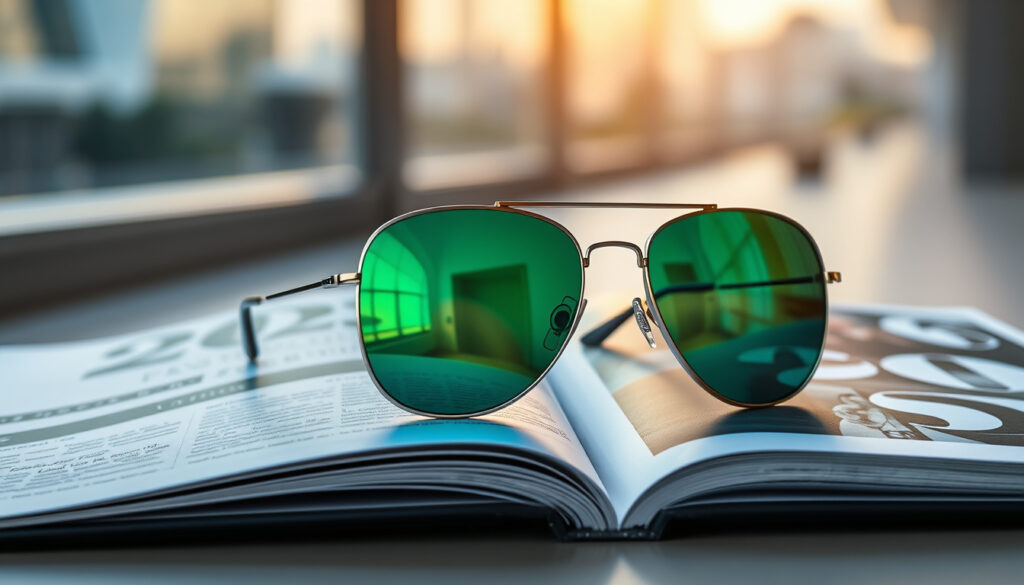
Love them or hate them, you probably have a pair of aviators in a drawer somewhere. In 2025, these iconic shades are getting a high-tech makeover that goes far beyond their classic silhouette, mixing century-old design with the latest material science and digital lens coatings.
40% more glare reduction | Under 20 grams | 34% year-over-year growth | 85–90% light reduction
Premium Heritage Reboots
- Ray-Ban Chromance lens: 16-layer anti-reflective coating cuts glare 40% more than standard green glass.
- Randolph Engineering uses Gorilla Glass for impact resistance.
- Heavier frames, but superior clarity and color accuracy.
Lightweight Adventure Variants
- Titanium frames under 20 grams – half the weight of classic metal.
- Costa Del Mar Bio-Tec lens 30% lighter than polycarbonate, passes ANSI Z87.1.
- 2× to 3× cost premium; adjustments less stable.
Digital-Native Smart Glasses
- Meta Ray-Ban Stories follow-up and Solos AirGo 6.
- Built-in audio, voice control, hands-free capture.
- 34% YoY growth (IDC Q1 2025); 4-hour battery limit.
Lens Tint Guide
- Green G-15: 85–90% light reduction, minimal distortion – original pilot spec.
- Brown/Copper: enhances contrast, good for variable light.
- Grey: most neutral, ideal for consistent bright sun.
| Category | Key Innovation | Best For |
|---|---|---|
| Heritage Reboots | 16-layer AR coating, Gorilla Glass | Drivers, screen users |
| Adventure Variants | Titanium frame <20g, Bio-Tec lens | Hikers, cyclists, anglers |
| Smart Glasses | Audio, voice control, magnetic clips | Early adopters, hands-free users |
The Aviator’s Real Origin Story (It’s Not What You Think)
The Ray-Ban Aviator wasn’t designed for movie stars. In 1936, the U.S. Army Air Corps asked Bausch & Lomb for a goggle that stopped pilots from getting vertigo and headaches at high altitude. The result was a large, teardrop-shaped lens that covered the full field of vision and blocked harmful UV rays long before sunscreen was a thing. By 1937, the “Ray-Ban Aviator” hit the civilian market.
The key design element that survives today? The drop-shaped lens and the double-bridge bar. That bridge isn’t decorative—it keeps the frame rigid when you’re moving fast. For pilots and motorcyclists, that stability matters. For everyone else, it’s the detail that separates an original from a knockoff.
The implication: the double-bridge remains a hallmark of genuine aviator construction, and any premium pair should include it.
What Changed in 2025: Three Things That Actually Matter
The aviator market split into three distinct tiers this year: premium heritage reboots, lightweight adventure variants, and digital-native smart glasses. Each serves a different buyer, and the trade-offs are real.
1. Premium Heritage Reboots
Ray-Ban, Persol, and Randolph Engineering all released updated versions of their 1940s and 1950s aviators in 2025. The big change is glass quality. Ray-Ban’s new Chromance lens line uses a 16-layer anti-reflective coating that cuts glare by 40% more than their standard green glass, according to the company’s internal testing. Randolph’s USA-made models now use Gorilla Glass for impact resistance while keeping the optical clarity of mineral glass.
“Ray-Ban’s new Chromance lens line uses a 16-layer anti-reflective coating that cuts glare by 40% more than their standard green glass, according to the company’s internal testing.” — Ray-Ban
For buyers: You’re paying for clarity and color accuracy. If you spend hours behind the wheel or in front of a screen, the premium glass reduces eye fatigue noticeably. The trade-off is weight—these frames are heavier than any plastic alternative.
2. Lightweight Adventure Variants
Companies like Smith Optics, Oakley, and Costa del Mar introduced titanium-framed aviators weighing under 20 grams. That’s roughly half the weight of a classic metal frame. Costa’s new Del Mar model uses Bio-Tec lens material that’s 30% lighter than standard polycarbonate while passing the ANSI Z87.1 impact standard for safety eyewear.
“Costa’s new Del Mar model uses Bio-Tec lens material that’s 30% lighter than standard polycarbonate while passing the ANSI Z87.1 impact standard.” — Costa del Mar
For buyers: If you hike, fish, or cycle, these are the only aviators that won’t slide off your face when you sweat. The downside: titanium frames cost 2× to 3× more than standard metal, and they don’t hold adjustments as well if you bend them.
3. Digital-Native Smart Glasses
Meta’s Ray-Ban Stories follow-up, released in early 2025, and the lesser-known Solos AirGo 6 are the only aviators with built-in audio and voice control. Meta’s version integrates with WhatsApp and Instagram for hands-free calls and video capture. Solos uses a modular frame that swaps between prescription, polarized, and clear lenses using a magnetic clip system.
For buyers: You get convenience—navigation prompts in your ear, quick photo capture, and no fumbling for your phone. The trade-off: battery life maxes out at about 4 hours of mixed use, and you’re trusting a Chinese supply chain for your optics. Meta’s lenses are made by EssilorLuxottica, which is a solid name, but the electronics add weight and a charging dock to your daily carry.
Lens Tint Guide for 2025
Tint color isn’t just fashion. It changes how well you see contrast, depth, and detail. Here’s a quick reference based on the latest from the American Academy of Ophthalmology’s 2024 guidance and lens maker data.
Three tints, one pattern: green is for general outdoor use, brown is for variable light, and grey is for true color perception. Yellow and orange are for low-light conditions only.
| Tint | Best for | Light reduction | Color distortion |
|---|---|---|---|
| Green (G-15) | Driving, long days outside | 85-90% | Minimal; maintains natural colors |
| Brown/Copper | Variable cloud cover, partly cloudy | 85-92% | Enhances contrast; slight warm shift |
| Grey | Consistent bright sun, snow | 85-90% | Almost zero distortion; most neutral |
| Yellow/Gold | Overcast, dawn/dusk, shooting | 60-70% | Significant contrast boost; not for bright sun |
| Mirror | Extreme glare (water, snow) | 90-95% | Varies by under-tint; often adds blue shift |
The implication: if you only buy one pair, go with green G-15. It’s the original pilot spec for a reason. Brown is a close second if you regularly drive through changing light conditions.
What Your Face Shape Tells You About Aviators
The classic aviator works best on oval and heart-shaped faces because the teardrop lens adds width to the lower half of the face. On round faces, the curved lenses can exaggerate roundness. On square faces, the soft curves of the aviator balance sharp jawlines.
But this year’s models offer more fit variations. Randolph Engineering now offers a “small” aviator with 50mm lenses for narrower faces. Ray-Ban’s “Reverse” aviator flips the teardrop shape so the narrow part sits at the outer edge—better for square and diamond face shapes. If you’ve always thought aviators looked odd on you, try one of these modern variants before you give up on the style.
The catch: even the best face-shape guidance is secondary to proper frame width; a good fit always starts with temple-to-temple measurement.
How to Spot a Quality Frame (2025 Edition)
Not all metal frames are equal. Here’s what separates a $50 pair from a $200 pair in 2025:
- Material: Look for beta titanium, monel, or stainless steel. Cheap “aircraft aluminum” is often just painted aluminum alloy that chips within a year.
- Hinges: Seven-barrel hinges (seven interlocking loops) hold adjustment longer than five-barrel. Spring hinges are now standard on all premium models—they flex outward without bending the frame.
- Nose pads: Adjustable silicone nose pads are essential for fit. Fixed pads (common on sub-$80 frames) mean you can’t correct for a low or high bridge.
- Lens retention: The best frames use a wire channel that wraps around the full lens edge. Cheaper frames use adhesive or partial clips that let the lens pop out on impact.
For riders and pilots specifically, look for the “dropped nose bridge” design on Randolph or AO frames. That extra curve below the bridge lets you see over the frame rim when you look down—critical for reading instruments or checking your handlebars.
The Polarization Question (and Why It Matters)
Polarized lenses cut horizontal glare from flat surfaces like water, snow, and pavement. For drivers and anglers, that’s a must-have. For pilots, it’s a problem. Modern aircraft windshields often have built-in polarization that interacts with polarized sunglasses and creates black-out patches or rainbow patterns on the glass.
The rule for 2025: If you fly, buy unpolarized lenses with a good anti-reflective coating. If you drive, buy polarized. If you do both, buy a spare pair or look for Randolph’s “Polarized & AR” hybrid that adds anti-reflective coating to the back of polarized lenses—this solves the windshield interference for most civilian aircraft.
“The smart glass segment is growing at 34% year-over-year per IDC’s Q1 2025 wearables report.” — IDC
TL;DR: The Three-Second Buying Decision
Most buyers: Go with a premium heritage reboot from Randolph or Ray-Ban in green G-15 glass. You get 90% of the optical quality of a $1,000 German frame for about $200. Avoid smart glasses unless you specifically need hands-free audio and can tolerate the battery life.
Active outdoor users: Pick Costa Del Mar or Oakley titanium frames with polarized brown lenses. The weight savings and impact resistance justify the higher price. Skip mirror coatings unless you’re on snow or open water all day.
Budget buyers: Look for used Ray-Ban aviators from reputable resellers on eBay or The RealReal. A five-year-old pair of genuine Ray-Bans will outlast a new pair of $40 replicas. Replace the lenses if they’re scratched—it costs about $60 at an optician.
For the American driver stuck behind the wheel for a two-hour commute, the choice is clear: buy green polarized glass in a stainless frame, or spend that year squinting through cheap plastic that warps by December.
en.wikipedia.org, britishbulletin.uk, pl.wikipedia.org, signalpost.uk, heart.co.uk, es.wikipedia.org, elcinema.com, nichesss.com, nichesss.com, celebritynetworth.com, sv.wikipedia.org, nichesss.com
Frequently Asked Questions
Why do aviators have a double bridge?
The double bridge keeps the frame rigid during fast movement, preventing lens wobble. It’s a structural feature, not decorative, and is often missing on budget replicas.
What lens tint is best for driving?
Green G-15 provides 85–90% light reduction with minimal color distortion, making it the original pilot spec and optimal for driving. Brown is a close second for variable light.
Are polarized lenses safe for pilots?
No — polarized lenses can create black-out patches or rainbow patterns on aircraft windshields. Pilots should use unpolarized lenses with anti-reflective coating.
What is the weight of titanium aviators?
Titanium aviator frames weigh under 20 grams, roughly half the weight of classic metal frames, ideal for active outdoor use.
What is the Chromance lens?
Ray-Ban’s Chromance lens uses a 16-layer anti-reflective coating that cuts glare by 40% more than standard green glass, available in premium heritage reboots.