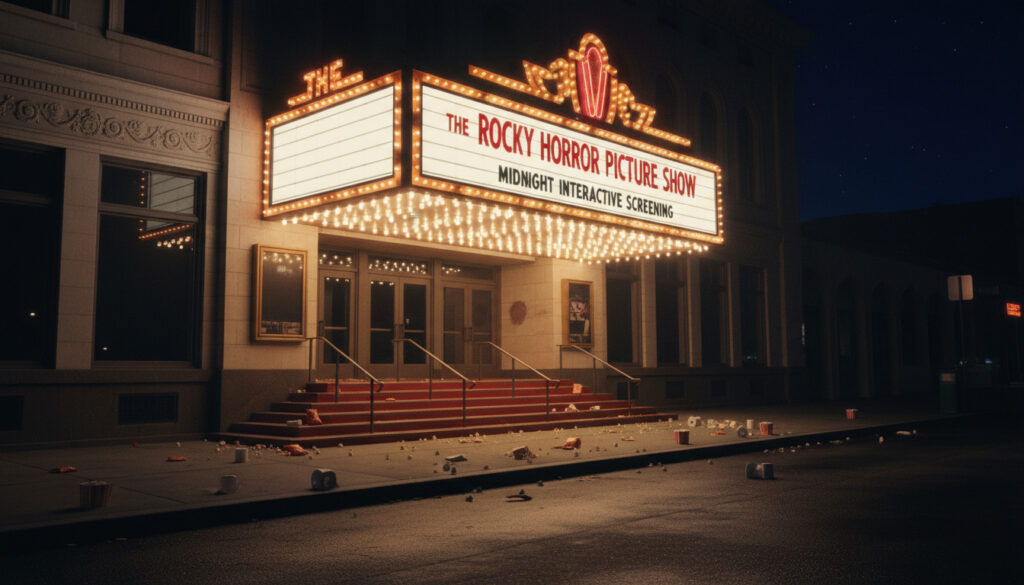
Rocky Horror Picture Show – History, Cast, Midnight Shows
The Rocky Horror Picture Show remains the longest-running theatrical release in cinema history, having never left theaters since its 1975 debut. This musical horror comedy follows Brad Majors and Janet Weiss, a straitlaced couple who stumble into the castle of Dr. Frank-N-Furter, a charismatic mad scientist from Transsexual, Transylvania, during a stormy night.
Originally conceived as a stage production by Richard O’Brien, the film transformed from a commercial failure into a global phenomenon through midnight screenings that began in 1976. Nearly five decades later, audiences continue to attend interactive showings dressed as characters, armed with props, and prepared to shout synchronized responses at the screen.
The work occupies a unique cultural position, celebrating outsider identity and gender fluidity while fostering communal experiences that transcend traditional cinema etiquette. Its influence extends beyond film into theater revivals, television adaptations, and an official sequel, cementing its status as a touchstone of counterculture expression.
What is The Rocky Horror Picture Show?
- Transformed from box office flop to cultural phenomenon via midnight screenings starting April 1976
- The “Time Warp” dance sequence became a global pop culture staple with specific choreography
- Tim Curry’s portrayal of Dr. Frank-N-Furter established his career and became an iconic performance
- Annual Halloween screenings remain a tradition in theaters across multiple continents
- Holds the record for longest continuous theatrical run, never withdrawn by 20th Century Fox
- Spawned the official 1981 sequel Shock Treatment
- Shadow cast performances continue globally, with live actors miming scenes in front of the screen
| Fact | Detail |
|---|---|
| Original Stage Premiere | June 16, 1973, Royal Court Theatre Upstairs, London |
| UK Film Release | August 14, 1975 (limited) |
| US Film Release | September 29, 1975 |
| Director | Jim Sharman |
| Writer | Richard O’Brien |
| Runtime | 100 minutes |
| Budget | $1.4 million |
| First Midnight Screening | April 2, 1976, Waverly Theater, New York City |
| 2026 Broadway Revival | Studio 54, starring Luke Evans (opens March 26) |
When was The Rocky Horror Picture Show released and its history?
Origins in London’s Fringe Theater
Richard O’Brien conceived The Rocky Horror Show in 1972 as a rock-flavored science fiction and horror pastiche incorporating camp elements, monsters, and aliens. The stage musical previewed on June 16, 1973, at the Royal Court Theatre Upstairs in Sloane Square, London, under Jim Sharman’s direction. Tim Curry originated the role of Dr. Frank-N-Furter, while O’Brien himself played Riff Raff. The production ran for 2,960 performances across multiple London venues until September 13, 1980.
Transatlantic Expansion
The American stage debut occurred on March 19, 1974, at Los Angeles’ Roxy Theatre, with Curry reprising his role and Meat Loaf joining as Eddie/Dr. Scott. The nine-month run attracted celebrities including John Lennon and Mick Jagger. A Broadway transfer followed, beginning previews on March 10, 1975, at the Belasco Theatre, though it closed after only 45 performances on April 5, 1975.
Film Production and Initial Reception
Principal photography commenced on October 23, 1974, at Oakley Court and Bray Studios near Windsor, England, concluding on December 21, 1974. Sharman returned to direct O’Brien’s screenplay adaptation. The UK limited release occurred on August 14 and 29, 1975, followed by the US premiere on September 26, 1975, at Los Angeles’ UA Westwood Theater. General American distribution began on September 29, 1975. Initial critical and commercial reception proved disappointing.
The first midnight screening took place on April 2, 1976, at New York’s Waverly Theater. By September 1976, audiences had developed call-back routines shouted at the screen. Standardized prop participation, including throwing toast and rice, emerged by April 1977, according to archival documentation.
Who is in the Rocky Horror Picture Show cast and who directed it?
The Creative Vision
Jim Sharman directed both the original 1973 London stage production and the 1975 film adaptation, maintaining continuity between the two iterations. Richard O’Brien served as screenwriter and composer, adapting his own stage book for the screen while reprising his role as Riff Raff. Their collaboration preserved the theatrical camp aesthetic while expanding the visual scope through cinematic techniques.
Principal Cast Members
Tim Curry starred as Dr. Frank-N-Furter, the “Sweet Transvestite from Transsexual, Transylvania,” delivering a performance that defined his career. Susan Sarandon portrayed Janet Weiss, while Barry Bostwick played her fiancé Brad Majors. The ensemble included Richard O’Brien as Riff Raff, Patricia Quinn as Magenta (and the Usherette), Little Nell as Columbia, Jonathan Adams as Dr. Scott, Peter Hinwood as Rocky Horror, Meat Loaf as Eddie, and Charles Gray as the Narrator. Cast records confirm many performers reprised their roles from the stage productions.
The chemistry between Sarandon and Bostwick provided the narrative anchor of normalcy against which Curry’s flamboyant antagonist could contrast. Meat Loaf’s musical number “Hot Patootie” became a particular highlight, showcasing his vocal range before his mainstream breakthrough.
Why is Rocky Horror Picture Show a cult classic?
The Shadow Cast Phenomenon
The film’s cult status crystallized through the “shadow cast” tradition, where costumed performers mime the action on screen while the film plays behind them. This practice began organically in 1976 and 1977, with fans dressing as characters during midnight screenings. Today, hundreds of shadow casts operate worldwide, with organizations like the one founded by Sal Piro in 1977 maintaining official fan communities.
Veteran attendees typically bring toast, newspapers, water pistols, rubber gloves, and party hats for specific cues during the screening. The Encyclopaedia Britannica notes these rituals evolved between 1976 and 1977, though individual theaters maintain varying policies regarding permitted props.
Audience Participation Culture
Beyond props, the film engendered a complex system of call-backs, where audiences shout scripted responses at characters during dialogue pauses. These phrases vary by region and theater, creating localized dialects of interaction. The phenomenon transformed passive viewing into active performance, with documentation confirming the film’s unique record for continuous theatrical exhibition.
Newcomers should verify specific theater customs before attending, as participation rules differ significantly between venues. Some locations prohibit items that others encourage, and call-back scripts vary by region.
How did The Rocky Horror Picture Show evolve across five decades?
- : Stage premiere at Royal Court Theatre Upstairs, London
- : US stage debut at Roxy Theatre, Los Angeles
- : UK limited film release
- : US general film release
- : First midnight screening at Waverly Theater, NYC
- : Official fan club founded by Sal Piro
- : Sequel Shock Treatment released
- : US television premiere on Fox
- : 25th anniversary celebrations and Broadway revival (437 performances)
- : Television reimagining airs on Fox
- : 50th anniversary commemorations
- : Scheduled Broadway return at Studio 54 starring Luke Evans (New York Theatre Guide)
What facts are established versus uncertain about Rocky Horror Picture Show?
| Established Information | Uncertain or Variable Details |
|---|---|
| Precise release dates (UK: August 14, 1975; US: September 29, 1975) | Current streaming availability varies by region and licensing agreements |
| Director Jim Sharman and writer Richard O’Brien credits | Specific prop policies at individual theaters (check local venues) |
| Complete principal cast list and character assignments | Exact attendance figures for modern midnight screenings |
| Midnight screening origins at Waverly Theater (April 2, 1976) | Regional variations in callback scripts and participation traditions |
| 2026 Broadway revival date and venue (Studio 54, March 26) | Future anniversary event specifics beyond 2025 |
What cultural significance does The Rocky Horror Picture Show maintain?
The film emerged as a sanctuary for LGBTQ+ communities and social outcasts during the 1970s, offering rare mainstream representation of gender fluidity and queer sexuality. Dr. Frank-N-Furter’s unapologetic transvestism and pansexuality challenged contemporary norms, while the narrative structure—celebrating the “other” while mocking conventional American values—resonated with audiences marginalized by mainstream culture.
The participatory nature of screenings created communal spaces where identity experimentation became socially acceptable. Unlike traditional cinema’s passive consumption, Rocky Horror demanded physical engagement, fostering connections between strangers through shared ritual. This aspect influenced subsequent cult films and interactive entertainment formats, establishing a template for fan-driven cultural phenomena.
Academic analysis frequently cites the work as a transitional artifact between 1960s counterculture and 1980s alternative scenes, bridging glam rock aesthetics with punk’s DIY ethos. Its endurance suggests continued relevance regarding body autonomy, sexual freedom, and the subversion of traditional family structures, themes that maintain urgency in contemporary discourse.
What do primary sources document about the production?
Historical records from official production archives confirm the timeline from O’Brien’s 1972 conception through the 1980 stage closure. Interviews with O’Brien, Curry, and Quinn conducted during 1994 birthday celebrations and 2000 anniversary events provide primary documentation regarding casting decisions and production challenges.
The stage production ran 2,960 performances across London venues from 1973 through 1980, establishing the foundation for the film’s subsequent cult status.
— New York Theatre Guide, citing production records
Contemporary reviews and box office records from 1975 document the film’s initial commercial failure, contrasting sharply with the revenue generated through midnight screenings beginning in 1976. The 1981 sequel Shock Treatment, which evolved from O’Brien’s unproduced script Rocky Horror Shows His Heels, represents the only authorized cinematic continuation, though the 1996 script Revenge of the Old Queen remains unproduced.
What should new audiences understand about The Rocky Horror Picture Show today?
Contemporary audiences encountering the film for the first time should recognize it as both a historical artifact of 1970s glam culture and a living tradition that continues evolving through audience participation. While the 1975 film remains the canonical text, the experience varies significantly between home viewing and theatrical attendance, with the latter offering the communal interaction that sustains the work’s relevance. Those interested in casting details from other productions might reference the Reacher Season 3 Cast – Full List of Actors and Roles for comparative ensemble analysis, while the David Harbour Lily Allen – Relationship Timeline and Split provides context on how celebrity relationships intersect with entertainment culture similar to the high-profile dynamics seen in Rocky Horror’s original casting.
Frequently Asked Questions
How did Rocky Horror Picture Show become popular?
The film achieved popularity not through initial release but via midnight screenings beginning April 2, 1976, at New York’s Waverly Theater. Word-of-mouth spread among college students and counterculture audiences, who developed interactive rituals that transformed the film into a participatory event.
What are Rocky Horror midnight shows?
Midnight shows are theatrical screenings typically occurring at 12:00 AM where audiences dress as characters, bring props like toast and newspapers, shout callbacks at the screen, and watch shadow casts perform live in front of the projection. These events began in 1976 and continue globally.
Where to watch Rocky Horror Picture Show?
The film maintains continuous theatrical exhibition through midnight showings at venues like NYC’s IFC Center. Home media includes Blu-ray (2010, 4K scan) and previous VHS/CD releases. Streaming availability varies by region and platform licensing; viewers should verify current options locally.
What are the best songs from Rocky Horror Picture Show?
The soundtrack features “Time Warp” (the iconic audience participation dance), “Sweet Transvestite,” “Dammit Janet,” “Science Fiction/Double Feature,” “Hot Patootie,” and “Touch-a, Touch-a, Touch Me.” The complete score includes fourteen musical numbers.
Is Rocky Horror Picture Show based on a stage show?
Yes. The film adapts The Rocky Horror Show, which premiered June 16, 1973, at London’s Royal Court Theatre Upstairs. Richard O’Brien wrote the book, music, and lyrics, with Jim Sharman directing both the original stage production and the film adaptation.
More related posts
 Sunday Kalogeras: Age, Birthday, Sisters & Facts
 Mobile Auto Electrician Near Me – On-Site Electrical Repairs
 Rachel Reeves Pension Tax Plans: Salary Sacrifice Cap
 What Does CAT S Mean – Rugged Smartphones Explained
 Work From Home Jobs No Experience: Ireland Remote Openings
 Richard Osman Net Worth: TV Host Turned Best-Selling Author
 What Is a Labubu? Viral Collectible Plush Explained
 What Does ISTG Mean – Texting Slang Guide and Examples